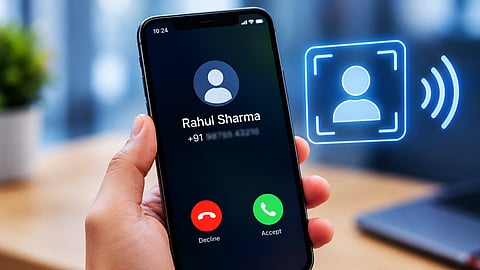

The Government of India has directed telecom service providers to introduce Calling Name Presentation (CNAP), a caller identification service designed to display a caller’s name alongside their phone number, from November 1, 2026. The rollout will initially cover 4G and higher-generation mobile networks, including 5G, allowing users to identify many callers whose numbers are not saved in their contacts.
According to reports published on October 15, the Department of Telecommunications (DoT) issued directions dated October 13 for the rollout. The service will be enabled by default on supported networks, without requiring users to submit a separate request
What Is CNAP and How Will It Work?
Calling Name Presentation is a telecom-network-based caller identification system. Unlike third-party caller identification apps, it is designed to retrieve the caller’s name from information maintained by telecom operators.
When an incoming call arrives, the recipient’s phone will display the caller’s number and name. If the number is already saved in the recipient’s contacts, the saved contact name will appear. For an unsaved domestic number, the system will display the name recorded in the originating telecom operator’s subscriber database.
For international calls, the display will show the words “International Call”, according to the reported guidelines.
Will CNAP Work on All Mobile Networks?
The initial rollout is intended for 4G and newer mobile networks, including 5G. The introduction of the service on 2G and 3G networks, as well as public switched telephone networks used for traditional landline services, will be considered separately.
This means the initial implementation will not necessarily cover every mobile network generation or fixed-line connection.
How Will Telecom Operators Handle Caller Data?
Telecom service providers will be required to maintain databases linking subscribers’ names with their telephone numbers. The recipient’s operator will retrieve the relevant information through the telecom network to display the caller’s identity.
The reported directions also require operators to follow a security-by-design approach. The caller’s name must not be retained through the query-response mechanism after the incoming call ends.
The framework also provides an exception for subscribers who have activated the Calling Line Identification Restriction (CLIR) facility, under which their caller-name identity will not be displayed as specified in the guidelines.
Can Businesses Display a Different Name?
The framework allows telecom operators to offer eligible business and bulk-connection users the option of displaying a preferred name instead of the name in their subscriber records.
However, the preferred name must meet specified registration requirements. It must be either a trademark registered in the user’s name with the Trade Marks Registry or a trade name registered on the Goods and Services Tax portal.
Telecom operators will have to verify the name and supporting documents before approving the change. Existing subscribers who wish to update their preferred name will need to apply through the prescribed process
Why Is the Government Introducing CNAP?
The rollout follows earlier trials on 4G and 5G networks and regulatory discussions on standardising caller identification. The Telecom Regulatory Authority of India (TRAI) issued recommendations on introducing CNAP in February 2024 and responded to a further reference from the DoT in October 2025.
TRAI’s October 2025 response addressed the DoT’s proposal to make the service available by default, rather than limiting activation to users who request it.
Will CNAP Eliminate Unknown or Fraudulent Calls?
CNAP is expected to make it easier to identify callers by showing the name associated with their telecom subscriber records. It may also reduce reliance on separate caller identification applications for basic name display.
However, seeing a caller’s name does not guarantee that a call is genuine or safe. Users should continue to exercise caution, avoid sharing one-time passwords or banking details over unsolicited calls, and independently verify suspicious requests.
The November 1 rollout is therefore a significant change to caller identification on supported networks, but it should not be treated as a complete solution to spam calls or telecom fraud.
