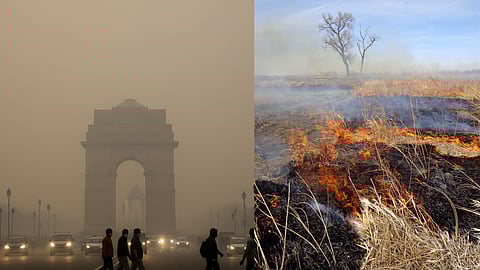

India's National Capital- New Delhi continues to face the problem of poor Air Quality. In multiple areas, Delhi's AQI continues to remain in red zone i.e. very poor. For instance, Central Pollution Control Board (CPCB) 2 pm recording suggests that Anand Vihar's AQI was very poor at 386. Similar, AQI are there around 2 pm on December 3.
Interestingly, Centre on Monday informed the Parliament of a 90 percent reduction in stubble burning i.e. farm fires incidents across Punjab and Haryana during the 2025 paddy harvesting season as compared to 2022.
Union Minister of Environment, Forest and Climate Change Bhupendra Yadav responded to Congress MP Charanjit Singh Channi's question by stating that while farm fires remain an episodic contributor to winter pollution, Delhi's air quality is influenced by multiple factors, including vehicular emissions, industrial pollution, construction dust, waste burning, and adverse weather conditions.
Abhjeet Yadav, Co-Founder at UPSC Prep.com, talking to a TV Channel explained the reason behind it.
"Not all of them can be put aside (farm fires, vehicular emissions, industrial pollution, construction dust, waste burning, etc). But, one of the key reasons behind Delhi Air Pollution is geography. If you see elevation map of India, to the north of Delhi we have massive boundary which is Himalaya, nothing goes beyond there. To the south we have Vindhyas over there, and then you have Aravalli range.
So, what is happening is there is air pocket which is sandwich. The Air is not moving north or not moving south. One problem is this.
The second problem is there is something called inversion. During winters in Delhi, the surface gets heated up during the day. Warm air has a tendency to rise up but at night land gets cool faster. So, when land gets cool, surrounding air also gets cool. It is a property of atmosphere that it gets heated up more by land air rather than sunlight.
So, warm air is rising up but a pocket of cold air is below. And, in this pocket of cold air we have a lead. This lead is called temperature inversion lead. In this particular case, there is cold air beneath, there is warm air, then there is colder air above. Just because of this, the smog layer is trapped beneath and not going up in the air.
This layer is called planetary boundary layer and it changes on height. Like during the daytime when the surface is getting heated, this layer will go high somwhere around 500-800 meters, at night it gets compressed. Because the same amount of pollutants are half in the space, you generally see clogged smog.
Now, the question arises why is the warm air not rising up? For this you have to understand global wind circulation. There is simple idea, hot air rises up, and cold air falls down. Around the time of October, November and December in Delhi, what is happening is there is massive downwelling of cold air. But, the clogged air not going anywhere because its pressured from both sides. This is why Delhi is witnessing extended period of bad air quality.
Now, the final piece of the puzzle is the Gangetic Basin. Nothing is moving north because of Himalayas, nothing is moving south because of Vindhyas and Aravalis. Winds are also not going to upper level because of capped inversion layer. Only way is to pass the air is towards east, but it is not going because there is no such wind that can do that.
Monsoon winds are no more blowing. After monsoon, this area does not have any circulation. Therefore, block of air is not moving anywhere. Due to this any kinds of pollution is not able to escape and staying on top of Delhi."
