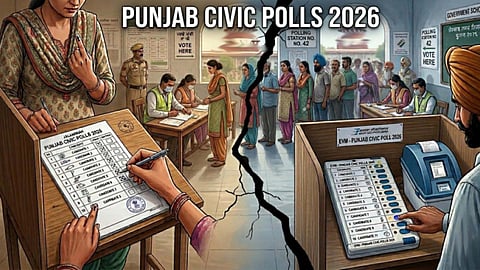

Punjab’s recent civic body elections have brought back an old question that many voters thought was settled years ago: Ballot paper or EVM? As for many people voting now means pressing a button on an Electronic Voting Machine (EVM) but in Punjab’s municipal elections held on this May 26 voting took place through the very traditional method of ballot papers instead.
The decision led to a legal battle that reached Supreme Court just one day before polling and the case has now become an important part of the discussion around Punjab’s local body elections and future of voting systems in state.
Punjab State Election Commission (SEC) decided to conduct elections through ballot papers instead of EVMs for 104 municipal bodies including eight municipal corporations and this decision was challenged in court by social worker Ruchita Garg who argued that elections should be held through EVMs and the matter first went to Punjab and Haryana High Court and later even reached Supreme Court as well however, on May 25 just one day before polling Supreme Court refused to stop election process or direct the authorities to switch to EVMs and the court said there was simply not enough time left before voting and Chief Justice of India Surya Kant observed that elections were scheduled for the very next day and asked “There is no time left. What can be done?”
The petitioner's side argued that India had largely moved from ballot papers to EVMs and that the Supreme Court had earlier described going back to ballot papers as a “regressive step” and they said EVMs were available and should have been used while on the other hand State Election Commission said the situation was more complicated and according to submissions before High Court the required EVMs were not made available within timeline needed for the elections.
Election officials argued that even after receiving machines they would need time for testing, training, allocation and other preparations before polling could be conducted smoothly so in simple words the problem was not about whether EVMs are good or bad but rather it was whether they could be arranged and prepared in time.
One of the biggest questions during Punjab’s civic body elections was simple: if EVMs are normally used why were voters suddenly asked to vote through ballot papers? Well according to Punjab State Election Commission (SEC) this decision was taken because Electronic Voting Machines (EVMs) were not made available within required timeline and during proceedings in Punjab and Haryana High Court SEC stated that Election Commission of India (ECI) had not provided machines as per schedule finalised for municipal elections however, ECI gave a different version and informed High Court that EVMs had already been dispatched from Rajasthan to Punjab and could be made available for elections and ECI also said the process of checking and preparing the machines could be completed quickly.
Supreme Court made it clear that changing voting method just hours before polling could disrupt entire election process and said that while EVMs may be preferred the law still allows municipal elections to be conducted through either EVMs or ballot papers since ballot papers are still permitted under rules, the SEC had legal power to use them.
Justice Joymalya Bagchi also said that a decision may appear unwise to some people but that does not automatically makes it illegal and court therefore refused to stop the elections along with this the judges also rejected a request to appoint an election observer saying such intervention would be very serious during an ongoing election process.
For a common voter the difference is simple as in a ballot paper system voters stamp or mark the candidate of their choice on a paper sheet and the votes are then counted manually while in an EVM system voters press a button against candidate’s name and symbol and the votes are stored electronically and counting is generally faster due to obvious reasons.
On one hand supporters of EVMs say they reduce counting time and make large scale elections easier to manage while on the other hand supporters of ballot papers argue that physical paper creates a visible record of every vote and the debate has existed in India for years but Punjab’s civic polls brought it back into public discussion yet once again.
More than 7,500 candidates were contesting across municipal corporations, councils and nagar panchayats and stopping the elections at the very last minute could have affected months of preparation, campaigning and administrative work and that is one reason why Supreme Court repeatedly stressed that courts generally avoid interfering once election process has already started.
This controversy was not only about machines and ballot papers but it also highlighted how important election planning is and Supreme Court reminded authorities that for future elections, they should follow amended rules that provide for EVM use and at the same time court said that as long as ballot paper voting remains part of law, SEC can legally choose that option.
For voters in Punjab the key lesson is simple: the method of voting may change but the value of a vote remains the same so whether a voter presses a button on an EVM or marks a ballot paper the purpose is identical: choosing local leaders who will make decisions about roads, sanitation, water supply, street lighting and other everyday civic issues.
