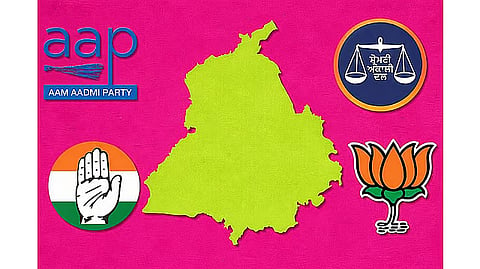

As Punjab heads towards the 2027 Assembly elections, the question of Panthic politics remains relevant, particularly because the Shiromani Akali Dal’s electoral strength has changed sharply over the past decade, however, the election data also shows that the “Panthic vote” cannot be measured directly through official election figures.
The Election Commission records votes and seats by political party, not by the religious identity of voters, therefore, SAD’s vote share cannot automatically be described as the size of Punjab’s Panthic electorate, but the last 10 Assembly elections, from 1977 to 2022, nevertheless show major changes in the parties competing for Punjab’s electorate.
In the 1977 Assembly election, Shiromani Akali Dal won 58 seats, while Congress won 17. The Janata Party won 25 seats.
SAD’s result made it the largest party in the Assembly and marked one of its strongest performances in the period covered by these 10 elections.
The political equation changed in 1980. Congress won 63 seats, while SAD won 37. BJP won one seat.
The result showed that Punjab’s electorate could move away from SAD even during a period when the party remained a major regional force.
In 1985, SAD won 73 seats, its second-highest tally in these 10 elections. Congress won 32 and BJP six.
The election came after a period of political and social turmoil in Punjab, and SAD returned to power under Surjit Singh Barnala.
Congress recorded its strongest performance in these 10 elections in 1992, winning 87 of the 117 seats.
BJP won six, BSP nine and SAD three.
The 1992 election was held amid the period of militancy in Punjab and recorded an exceptionally low turnout of about 23.8%. SAD had called for a boycott of the election.
In 1997, SAD won 75 seats, while BJP won 18 and Congress 14.
The SAD-BJP alliance therefore secured 93 seats, giving it a clear majority in the 117-member Assembly.
This became one of the strongest electoral performances of the alliance in Punjab.
Congress won 62 seats in 2002. SAD won 41 and BJP three.
The result again showed that the SAD-BJP combination did not permanently control Punjab’s electoral politics.
In 2007, SAD won 48 seats, BJP 19 and Congress 44.
The SAD-BJP alliance therefore won 67 seats, crossing the majority mark.
In 2012, SAD won 56 seats, BJP 12 and Congress 46.
The SAD-BJP alliance therefore won 68 seats and returned to government for a second consecutive term.
This was the first time since the reorganisation of Punjab in 1966 that a ruling party or alliance was re-elected for a second consecutive term.
The 2017 election marked another major shift.
Congress won 77 seats, AAP 20, SAD 15 and BJP three.
SAD’s seat tally fell from 56 in 2012 to 15. However, the party still received 25.24% of the statewide vote, according to ECI-based election data.
This is significant because the decline in seats was much sharper than the decline in vote share.
The biggest shift came in 2022.
AAP won 92 seats with around 42.01% of the vote. Congress won 18 seats with 22.98%, SAD three with 18.38%, BJP two with 6.60% and BSP one with 1.77%.
SAD’s result is particularly significant: it received 18.38% of the statewide vote but won only three seats.
This shows the difference between vote share and seat conversion. A party can retain a sizeable statewide vote but win relatively few constituencies if its support is spread across the state rather than concentrated enough to finish first in individual seats.
Across these elections, SAD went from 58 seats in 1977 to 75 in 1997, 56 in 2012, 15 in 2017 and three in 2022. Congress moved from 17 seats in 1977 to 63 in 1980, 87 in 1992, 77 in 2017 and 18 in 2022. AAP, which did not exist in the earlier elections, went from 20 seats in 2017 to 92 in 2022.
BJP remained a smaller Assembly force, winning 19 seats in 2007, 12 in 2012, three in 2017 and two in 2022. The data therefore shows repeated shifts in Punjab’s political centre of gravity rather than a permanently fixed Panthic voting bloc.
For 2027, the key issue is not whether Punjab has a single “Panthic vote”. Official election data cannot establish that. The more measurable question is how voters who have historically supported SAD, Congress, AAP, BJP and other parties respond to issues associated with Sikh identity, Punjab’s political rights and religious institutions.
