
Prime Minister Narendra Modi’s Punjab visit has emerged as a major political statement ahead of the 2027 Assembly elections, with the BJP combining infrastructure announcements, social outreach and aggressive political messaging to strengthen its presence in the state.
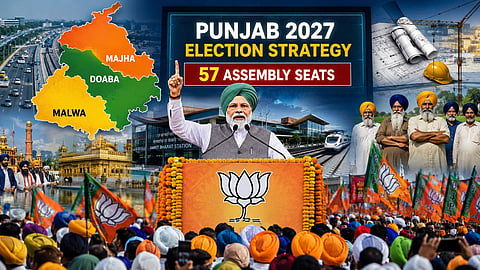
During his Jalandhar visit, PM Modi inaugurated and laid the foundation stones of 15 major development projects across Punjab. Beyond the infrastructure push, the political significance of these projects is being closely watched, as they are expected to influence around 57 Assembly constituencies — including 23 seats in Malwa, 23 in Doaba and 11 in Majha — covering nearly half of Punjab’s 117-member Assembly.
The visit also indicated that the BJP is preparing for an independent electoral battle in Punjab, with signals that the party could contest all 117 Assembly seats in the 2027 polls. In his address, Modi launched sharp attacks on the ruling Aam Aadmi Party (AAP), Congress and Shiromani Akali Dal, while highlighting the BJP’s vision of development-led governance.
Development Push Across Punjab’s Three Regions
The Prime Minister’s announcements focused heavily on strengthening Punjab’s road, railway and healthcare infrastructure.
In the Malwa region, districts including Ludhiana, Mohali, Rupnagar, Patiala, Sri Muktsar Sahib and Sangrur are set to benefit from projects such as the Southern Ludhiana Bypass, Delhi–Amritsar–Katra Expressway connectivity, IT City–Kurali Highway upgrades, railway station redevelopment and expansion of healthcare facilities at PGI.
In Doaba, which has a strong Punjabi diaspora connection, projects in Jalandhar, Hoshiarpur and Kapurthala were highlighted. These include the redevelopment of Jalandhar Cantt and Phagwara railway stations, highway improvements, the Daulatpur Chowk–Kartoli railway line and enhanced connectivity in the Kandi belt.
In Majha, districts including Amritsar, Pathankot and Gurdaspur are expected to benefit from railway upgrades and improved connectivity, including the launch of the Sant Ravidas Express connecting Amritsar with Varanasi.
Sant Ravidas Outreach and Dalit Vote Focus
A major political message from Modi’s visit was his outreach towards Punjab’s Dalit community.
Before the rally, the Prime Minister met Dera Sachkhand Ballan chief Sant Niranjan Das during his train journey. He also highlighted the legacy of Sant Ravidas Ji during his speech and referred to the newly introduced train service connecting Punjab and Varanasi.
With Punjab having one of the highest proportions of Scheduled Caste population in the country, political observers see this outreach as an attempt to strengthen the BJP’s connect with Dalit voters, particularly in the Doaba region, where the community holds significant electoral influence.
This was Modi’s second interaction with Sant Niranjan Das in five months, following his earlier engagement with the Radha Soami Dera Beas leadership, indicating the BJP’s continued focus on connecting with influential social and religious institutions in Punjab
‘Double-Engine Government’ Pitch
During his address, PM Modi promoted the BJP’s governance model by highlighting Haryana’s development initiatives, including MSP procurement on multiple crops, infrastructure expansion and cultural projects.
By comparing Haryana’s progress with Punjab, Modi sought to strengthen the BJP’s “double-engine government” pitch and present the party as an alternative focused on development and governance.
Green Turban Sends Farmer Outreach Message
PM Modi’s choice of wearing a green turban at the rally also attracted political attention. The colour is often associated with Punjab’s farming community, and the gesture was seen as an attempt to reconnect with farmers.
During his speech, Modi also highlighted agricultural policies in Haryana, including MSP-related measures, while presenting the BJP as committed to farmers’ welfare.
Sharp Attack on Political Rivals
The Prime Minister launched a strong attack on the AAP government, raising issues of law and order, drugs and governance. He also criticised Congress over internal differences and targeted the Shiromani Akali Dal over its political approach.
The messaging from the rally reflected the BJP’s attempt to position itself as the main challenger in Punjab ahead of the 2027 Assembly elections.
Political Significance of the Visit
The combination of major infrastructure projects, outreach to Dalit and Sikh communities, farmer-focused symbolism and a clear independent political strategy has made PM Modi’s Punjab visit one of the BJP’s most significant campaigns in the state.
With projects linked to 57 Assembly constituencies across Malwa, Doaba and Majha, the visit is being viewed as a strategic roadmap for the BJP’s expansion plans before the 2027 Punjab Assembly elections.
