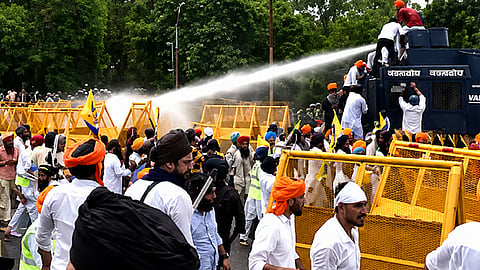

A protest by supporters of Akali Dal (Waris Punjab De), demanding the release of Khadoor Sahib MP Amritpal Singh and other Sikh prisoners, turned into one of the biggest security challenges Chandigarh has witnessed in recent years. Despite advance intelligence and weeks of planning, hundreds of protesters managed to breach multiple police barricades and reach within nearly a kilometre of Punjab Chief Minister Bhagwant Mann's official residence in Sector 2.
As protesters advanced towards the Chief Minister's residence, they overpowered the first line of barricades, briefly took control of a police water cannon, and clashed with security personnel. Several police officers sustained injuries before the crowd was eventually stopped.
Retired Punjab Director General of Police A.P. Pandey described the incident as a clear case of poor coordination and weak ground intelligence.
"This reflects a lack of coordination between Chandigarh and Mohali Police, along with inadequate ground intelligence. Such a large-scale demonstration required much stronger planning and deployment," he said.
Chandigarh Senior Superintendent of Police Kanwardeep Kaur defended the police response, stating that authorities had deliberately exercised restraint to prevent the situation from escalating into violence.
According to the SSP, police had been in constant touch with the organisers for nearly a week before the protest. While permission for a march was denied, organisers had been offered an alternative venue for a peaceful gathering.
"Despite repeated warnings, protesters broke through the barricades and moved forward. Some participants were carrying weapons, and several of our personnel were injured. Our priority was to avoid a larger law-and-order situation," she said.
Where the Security Plan Fell Apart
According to officials and sources familiar with the planning, Chandigarh and Mohali Police had held joint meetings before the protest and agreed on a coordinated strategy. Traffic advisories had also been issued and barricades were erected near Gaushala Chowk, where police intended to stop the procession.
However, the execution reportedly failed at multiple levels.
Sources said Mohali Police, instead of preventing protesters from advancing, escorted them up to the Chandigarh border before pulling back. Once inside Chandigarh, the responsibility shifted entirely to Chandigarh Police.
The first major confrontation occurred near Gaushala Chowk in Sector 45. Protesters quickly realised that police deployment at the barricades was insufficient. They seized a water cannon and broke through the barricades within minutes.
Perhaps the biggest operational lapse, according to security observers, was the absence of multiple security layers between Gaushala Chowk and the Chief Minister's residence. After crossing the first barricade, protesters encountered little resistance for several kilometres.
Protest Leadership Lost Control
Organisers had repeatedly claimed the demonstration would remain peaceful. MLA Manpreet Singh Ayali had publicly appealed for calm and urged supporters not to resort to violence.
However, once the crowd breached the initial barricades, the situation rapidly slipped beyond the organisers' control.
Young protesters continued moving forward despite repeated appeals from leaders to stop. Ayali himself attempted to halt the crowd near Labour Chowk, but many protesters ignored his instructions.
Later, Amritpal Singh's father, Tarsem Singh, climbed onto a vehicle and appealed through a public address system for protesters not to proceed further. By then, nearly 200 protesters had already moved ahead towards the high-security zone.
Police Changed Strategy to Protect CM's Residence
With protesters moving rapidly towards the VVIP area, senior police officers shifted their focus from crowd control to securing the Chief Minister's residence.
Officials immediately alerted the Chief Minister's Office, and OSD Amarinder Brar was called to receive the protesters' memorandum at Sector 7/8 Chowk in an attempt to prevent them from moving further.
Initially, police believed the crowd would disperse after submitting the memorandum. However, once security personnel relaxed their human chain, nearly 50 protesters continued marching towards Vigyan Path and crossed two additional intersections before being stopped near the Punjab Police Headquarters. By then, the crowd had gradually thinned, allowing police to regain control and escort the remaining protesters towards Mohali.
Experts Call for Better Intelligence and Coordination
Retired DGP A.P. Pandey said such incidents underline the importance of seamless coordination between Chandigarh Police, Punjab Police and other security agencies, particularly because Chandigarh serves as the joint capital of Punjab and Haryana.
He stressed that effective crowd management begins with accurate intelligence regarding the expected turnout, movement routes, deployment plans and clearly defined command responsibilities.
