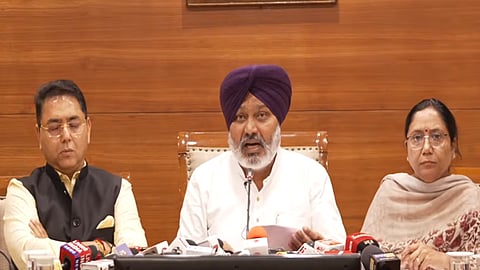

Cheema, Aman Arora and Baljit Kaur Jointly Address Employee Concerns
Amid growing tensions with nearly 7.50 lakh government employees and pensioners, the Punjab Government on Thursday put up a united front on the ongoing Dearness Allowance (DA) issue. Finance Minister Harpal Singh Cheema, Industry and Renewable Energy Minister Aman Arora and Social Security Minister Dr Baljit Kaur jointly addressed the media, defending the government’s position on salaries, DA and pending arrears.
The ministers said the government was willing to sit across the table with employees and pensioners to discuss their grievances. The press conference came after employees observed a mass casual leave on August 27 over demands including payment of pending DA arrears.
Cheema Highlights State’s Financial Burden
Finance Minister Harpal Singh Cheema said Punjab is spending 51 per cent of its revenue on salaries and pensions, compared with an all-India average of around 38 per cent.
He also said Punjab’s own tax revenue is considerably lower than the national average, making expenditure on salaries and pensions a significant financial commitment for the state.
Cheema said the state had increased DA by 14 percentage points in three instalments since 2022. According to him, DA was increased from 28 per cent to 34 per cent in October 2022, then to 38 per cent in December 2023, and finally to 42 per cent in November 2024.
₹14,191 Crore DA Arrears Liability
The Finance Minister said the state was dealing with a ₹14,191-crore liability on account of DA arrears, which he described as an inherited liability from previous governments, including the Congress and SAD-BJP regimes.
“We did not create this liability. We inherited it,” Cheema said.
He stated that the Mann government had submitted a liquidation plan, which was accepted by the court and was being implemented. According to Cheema, more than ₹4,500 crore has already been released to employees and pensioners against the inherited liability, with payments being made in monthly instalments.
Cheema also said the present government was the only one to have committed to paying the past DA arrears.
Article 14 Argument
Responding to criticism over Punjab not matching the Central Government’s DA rate, Cheema questioned the BJP’s argument regarding Article 14.
He referred to BJP-ruled states such as Haryana and Gujarat, asking why similar questions were not being raised about their DA arrangements.
Cheema also claimed that Haryana employees receive around 13 per cent less salary than their Punjab counterparts, and challenged the BJP to demand parity for Haryana employees with Punjab.
Baljit Kaur Cites State Rules
Dr Baljit Kaur said the relevant rules governing DA were framed in 2021 and that Punjab was paying DA in accordance with them.
She maintained that there was no provision under the state rules making it mandatory for Punjab to pay DA at the same rate as the Central Government.
Aman Arora Appeals for Dialogue
Aman Arora described government employees and pensioners as the “backbone of the government” and appealed for dialogue. At the same time, he alleged that the workforce was being used as a political tool by opposition parties.
Arora said the government was committed to resolving pay anomalies where Punjab employees were receiving less than their counterparts under Central Government scales.
He also said meeting DA demands at the required levels would involve an annual expenditure of around ₹6,500 crore, which, he argued, could otherwise be used for schools, healthcare and infrastructure.
Government Seeks Talks Amid Continuing Dispute
Cheema said he was scheduled to meet representatives of 10 employee unions and reiterated the government’s willingness to discuss their demands. He also defended action against employees who remained absent during the August 27 protest.
With employees continuing to raise demands over DA arrears and related pay issues, Thursday’s joint press conference saw three senior ministers collectively present the government’s financial, legal and administrative position on the matter.
