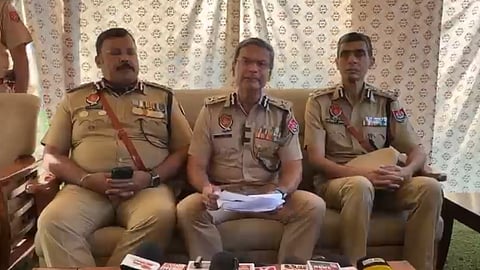

Punjab Police Director General of Police (DGP) Gaurav Yadav on Tuesday shared details of the state’s action against drug trafficking, gangsters and terror networks during the state-level Police Commemoration Day event in Jalandhar, and he said more than 95,000 FIRs had been registered under the Narcotic Drugs and Psychotropic Substances (NDPS) Act since March 16, 2022, resulting in over one lakh arrests.
According to the DGP, police have seized more than 7,200 kg of heroin during this period. Assets worth approximately ₹902 crore linked to drug trafficking cases have also been frozen. He said the conviction rate in NDPS cases stood at around 90 per cent.
The event also included tributes to police personnel who lost their lives in the line of duty. The concerns of their families were heard, and assurances were given that their issues would be addressed.
The Punjab government has launched a 60-day special campaign against drugs, focusing on areas identified as hotspots for drug-related activities.
According to the information shared by the police, Chief Minister Bhagwant Mann chaired a high-level meeting in Phillaur attended by officials from the police, district administration, and the Health, Education and Sports departments.
Under the campaign, police and civil administration officials have been assigned responsibility for specific hotspots. The focus will be on taking action against drug peddlers and suppliers while also addressing the conditions that allow drug-related activities to continue in these areas.
The plan includes developing sports grounds, installing streetlights and CCTV cameras, and providing rehabilitation support to people affected by drug addiction. The stated objective is to make identified hotspots drug-free and involve young people in positive activities.
Sharing details of action against organised crime, the DGP said the Anti-Gangster Task Force was established on April 6, 2022.
Since its formation, 3,326 members of criminal gangs have been arrested, while 1,288 gangster modules have been dismantled, according to the police.
The operations have also led to the recovery of 2,507 weapons and 62 vehicles. The police said action against gangsters and their networks was continuing.
On internal security, the DGP said Punjab Police had dismantled 86 terror modules and arrested 660 people during operations against terror networks.
The police reported recovering 88 improvised explosive devices (IEDs), 131 hand grenades, 28 kg of RDX and six rocket launchers during these operations.
According to the DGP, Punjab Police coordinates with the Border Security Force (BSF) and other central agencies to tackle terrorism, drug trafficking and narco-terrorism in the state.
The DGP also shared details of investments in police infrastructure and technology. According to the police, more than ₹1,600 crore has been invested in upgrading infrastructure, procuring modern equipment and software, and improving the capacity to investigate cybercrime.
The police have also worked towards setting up new cyber police stations and modernising investigation systems.
Future plans include targeting entire criminal networks, strengthening financial investigations and increasing administrative monitoring in drug hotspots.
During the event, a journalist raised questions about Union Home Minister Amit Shah's remarks on Punjab's drug problem and videos circulating on social media that allegedly showed narcotics being supplied under the guise of food delivery services.
Asked how police were tracking such suppliers and dismantling their networks, the DGP stressed the need for cooperation between the police, the public, civil society and other government departments.
He said arrests alone were not enough to tackle drug abuse and that rehabilitation of people affected by addiction was also necessary.
The police cited the conviction rate in NDPS cases as part of their action against drug trafficking. However, the statement available from the event did not provide specific details about the alleged use of food delivery services to supply narcotics.
The DGP's remarks come as the state government continues its campaign against drug trafficking, with the latest 60-day drive combining enforcement against suppliers with measures focused on rehabilitation and youth engagement.
