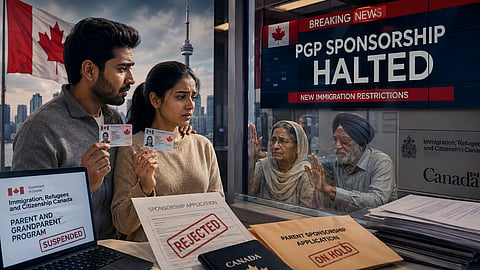

Millions of Indians living in Canada, especially the Punjabi community, have received a major setback. The Canadian government has suspended new sponsorship applications under the Parents and Grandparents Program (PGP) from July 15, 2026, until further notice.
With this move, new applicants who have already obtained Permanent Residency (PR) in Canada will no longer be able to apply to bring their parents and grandparents to Canada for permanent residence.
However, applications submitted on or before July 15, 2026, will continue to be processed as before. The decision is expected to have the biggest impact on Punjab, as Punjabis make up a significant portion of the Indian community in Canada. Thousands of families from the Doaba and Malwa regions have members settled in Canada, and the PGP program has been the main route for bringing parents to live with them permanently.
From July 15, 2026, Canada will no longer accept new Interest to Sponsor forms under the PGP program. New potential sponsors will also not be invited to submit applications. The suspension will remain in effect until further notice.
Applications submitted on or before July 15, 2026, will continue to be processed. The Canadian government has clarified that these applications will not be cancelled.
Around 60,000 PGP applications are already pending. Every year, the number of applications received is much higher than the available quota.
According to Immigration, Refugees and Citizenship Canada (IRCC), the priority is now to clear existing applications, reduce processing times, and maintain balance in the immigration system.
Parents and grandparents can still be brought to Canada through the Super Visa, but it does not provide Permanent Residency (PR).
According to IRCC, demand for the PGP program has consistently exceeded available spots, resulting in thousands of applications remaining pending for years.
The department said that pausing new sponsorship applications aims to:
Reduce the existing backlog
Speed up processing times
Improve management of the immigration system
Under Canada’s 2026–2028 Immigration Levels Plan, the government has set a target of granting PR to 15,000 parents and grandparents in 2026.
Punjabis have been among the largest groups moving to Canada for education and employment. Many people plan to bring their parents and grandparents permanently after receiving PR through the PGP program.
This decision has created three major impacts:
Thousands of families’ plans for family settlement have been put on hold.
The PR sponsorship route for new applicants has been closed temporarily.
Families will now have to depend mainly on the Super Visa option.
The main option available is the Super Visa.
Under this visa:
Parents can stay in Canada for up to 5 years at a time
The visa remains valid for up to 10 years
Multiple entries are allowed
Applicants can request an extension while staying in Canada
However, the Super Visa only allows long-term stay and does not provide PR status.
People who submitted their applications on or before July 15, 2026, will not be affected immediately.
All applications already under processing will continue, and the Canadian government has confirmed they will not be cancelled.
Family reunification has been an important part of Canada’s immigration policy. The suspension of the PGP program will affect the settlement plans of thousands of Indian and Punjabi families.
At present, the Super Visa remains the biggest legal option for parents and grandparents who want to stay with their families in Canada for a longer period.
Immigration education consultant Rajveer Chahal said that this is not a permanent closure of the PGP program.
According to him, if Canada manages to reduce the pending backlog in the future and increases immigration targets, the new sponsorship process could restart.
However, IRCC has not announced any timeline for reopening the program yet
