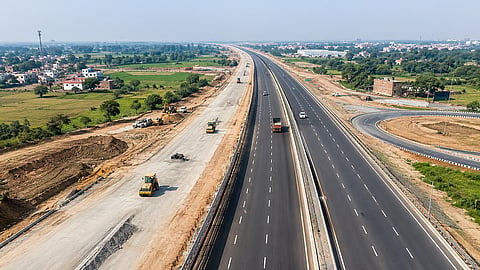

The National Highways Authority of India (NHAI) has issued a tender worth ₹1,274 crore for the remaining construction work on a 43-km stretch of the Delhi-Amritsar-Katra Expressway in the Doaba region. The project is expected to improve connectivity for Jalandhar, Kapurthala and nearby industrial and educational areas.
The deadline for submitting bids for Package 11 is November 19. The stretch will run from Khojewal near the IKG Punjab Technical University (IKG-PTU) campus to the Sri Hargobindpur-Tanda Road.
A new entry point is planned near the IKG-PTU campus on the Jalandhar-Kapurthala border. It will provide direct access to the expressway for commuters travelling from Jalandhar, Kapurthala, the Leather Complex and Science City. The project is also expected to benefit the Rail Coach Factory (RCF) area in Kapurthala.
A key feature of the project is a hybrid cloverleaf junction on the Jalandhar-Kapurthala highway. The four-ramp design will allow vehicles travelling from different directions to enter or exit the expressway without crossing oncoming traffic at a conventional road junction.
The junction will have curved ramps with a radius of around 350 to 450 metres. These loops are designed to allow vehicles to navigate turns before merging into the main expressway traffic through acceleration lanes.
The expressway is designed for vehicle speeds of up to 120 kmph. FASTag-enabled toll facilities are also planned at the entry and exit ramps to facilitate electronic toll collection.
The new junction is expected to make access to the expressway easier for residents and commuters in the Doaba region.
The project is expected to reduce travel time from Jalandhar to Delhi and Katra once the expressway becomes operational.
Currently, the journey from Jalandhar to Delhi takes around 6.5 to 7.5 hours. With the expressway in place, the travel time could come down to approximately 3.5 to 4 hours, potentially saving three to three-and-a-half hours.
Similarly, travelling from Jalandhar to Katra currently takes around 5.5 to 6.5 hours. The journey could take approximately three to three-and-a-half hours after the expressway is completed, saving around 2.5 to three hours.
These are projected travel times and may vary depending on traffic conditions, the final road connections and the route taken.
With the tender issued for Package 11, the next step is the bidding and contract-awarding process, followed by construction.
The 43-km stretch and its associated junction infrastructure are expected to be completed in phases. The construction timeline could extend to two years, according to the project details.
Once completed, the stretch is expected to improve road connectivity between Jalandhar, Kapurthala and the Delhi-Katra corridor, making travel easier for residents, commuters and businesses across the region.
