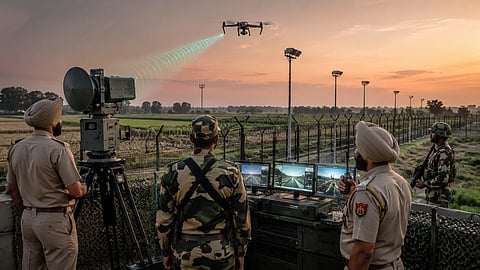

As cross-border smuggling through drones continues to pose a major security challenge along the India-Pakistan border, the Punjab Police have intensified their anti-drone strategy by deploying what they call "Hawai Nakas"—an aerial security network designed to detect and neutralise drones carrying narcotics, weapons and other contraband.
‘Hawai Naka’- Second line of defence
Director General of Police (DGP) Gaurav Yadav said the newly established "Hawai Nakas" act as a second line of defence, complementing the Border Security Force (BSF), which remains responsible for guarding the international border and the border fence. The term, coined by the Punjab Police, reflects the state's effort to establish aerial surveillance and dominance against drone-based smuggling
Drones as a key source of smuggling
Punjab shares a 553-kilometre international border with Pakistan, covering the districts of Pathankot, Gurdaspur-Batala, Amritsar Rural, Tarn Taran, Ferozepur and Fazilka. While traditional border infiltration remains a concern, officials say smugglers are increasingly relying on drones to deliver consignments of heroin, arms and ammunition, which are then quickly collected by local operatives.
Drones recovered till now
Official figures underline the growing scale of the challenge. Between January 2025 and July 27, 2026, security agencies recovered 474 drones and seized 777.474 kilograms of heroin along Punjab's border. In 2025 alone, authorities recorded 316 drone-related incidents, leading to the recovery of 313 drones and 385.119 kilograms of heroin. During the first seven months of 2026, another 161 drones were recovered, while heroin seizures rose to 392.355 kilograms, indicating that despite fewer drone recoveries, the quantity of narcotics being smuggled remains significant.
Costing of the Anti-drone system
To tackle the evolving threat, the Punjab Police have installed three anti-drone systems at a cost of nearly ₹53 crore. Two systems have been deployed in Tarn Taran, while one has been installed in Amritsar Rural, together covering nearly 210 kilometres across the districts of Ferozepur, Tarn Taran and Amritsar Rural. Officials said the deployment locations were selected after consultations with the BSF, the Army and intelligence agencies, based on recent drone activity and threat assessments.
Strategic ‘Naka’ points
The state's border security network has also been strengthened on the ground. Punjab Police have identified 64 strategic naka points across seven border districts, with 28 currently operational and staffed by 317 personnel, including 238 Punjab Police personnel and 79 Punjab Home Guards. Among these, 19 nakas are jointly manned with the BSF, ensuring better coordination between state and central security agencies.
Technology as a key component
Technology has also become a key component of the security architecture. Authorities have installed 87 CCTV cameras at 25 locations along the border surveillance grid, forming part of a larger network of 2,336 cameras established at a cost of ₹49.58 crore. Officials said this surveillance infrastructure allows security agencies to monitor suspicious movement more effectively and respond quickly to potential threats.
According to senior police officials, anti-drone operations have become a constant technological race, with smugglers continuously upgrading the drones they use while Indian security agencies enhance their detection and interception capabilities.
Replacements of outdated ‘naka’ points
Following a review of existing border security arrangements, four outdated naka points in Amritsar Rural were removed and replaced with three new hi-tech checkpoints. Of the 68 permanent nakas currently in service, 65 have now been upgraded, bringing overall compliance with modern security standards to 96 per cent.
A robust security framework
DGP Gaurav Yadav said the combination of aerial surveillance, anti-drone systems, joint BSF coordination, advanced CCTV monitoring and strategically located nakas has created a robust security framework aimed at disrupting cross-border smuggling networks before consignments can move deeper into Punjab.
Investment in security infrastructure
The Punjab Government has also sanctioned an additional ₹47.97 crore for 2026-27 to further strengthen border policing through the procurement of unmanned aerial vehicles (UAVs), bomb disposal equipment and bulletproof jackets for personnel deployed in border areas, signalling continued investment in modernising the state's security infrastructure.
