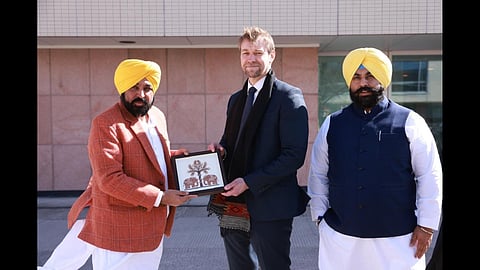

Punjab’s education system is witnessing a major shift as the state government, led by Chief Minister Bhagwant Singh Mann, collaborates with Finland’s University of Turku to bring global teaching practices into local classrooms.
The initiative, part of Punjab’s broader “Sikhya Kranti,” is already showing early impact, with classrooms moving away from traditional rote learning towards more joyful, participatory, and student-centred approaches. The programme focuses on blending international expertise with Punjab’s local context to improve foundational learning and student engagement.
As part of the collaboration, nearly 300 teachers are being trained through a structured “train-the-trainers” model. These educators will further pass on the learning, helping scale the programme across the state. Training sessions have been conducted both in Chandigarh and in Finnish cities like Turku and Rauma, where teachers were exposed to modern classroom practices through workshops, mentoring, and school visits.
During his visit to Finland, CM Mann toured early education centres and teacher training institutions, highlighting that the initiative is designed as a long-term reform, not a short-term intervention. He emphasized that the programme aims to embed child-centred, play-based, and inclusive teaching methods into Punjab’s education system.
Teachers involved in the programme have reported increased confidence, improved student participation, and more inclusive classroom environments. A key feature of the initiative is its focus on adapting global methods to local needs rather than directly copying foreign models.
Looking ahead, the Punjab government plans to expand the programme through digital platforms and continuous training, creating a strong network of master trainers. The collaboration is being positioned as a cornerstone of Punjab’s education reforms, aimed at preparing students with better skills for the future.
