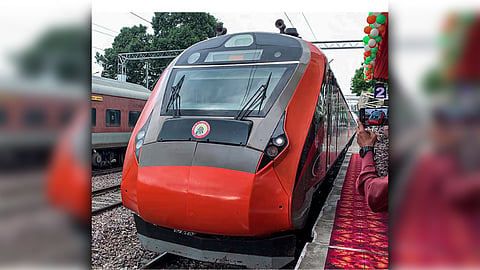

Good news from Punjab, the Rail Coach Factory in Kapurthala has taken another big step in India's railway modernisation. Its brand-new 16-coach Vande Bharat Chair Car train has successfully run at 180 km/h on the Mathura–Nagda section. The trial took place on October 8, 2026, with the Chief Commissioner of Railway Safety (CCRS) overseeing it.
Safety officials looked at how stable the train stays at 180 km/h, along with other key performance and safety parameters. The aim was simple: to confirm that a newly built train can run reliably at high speed under controlled conditions. A successful run like this brings the train closer to joining regular Indian Railways service.
Not yet, and not in regular service. The Ministry of Railways says these trains are designed for 180 km/h, but the maximum permitted operating speed is 160 km/h. The actual speed on any route will depend on safety clearances and the specific needs of that route.
The factory rolled out its first 16-coach Vande Bharat on March 31, 2026, fitted with an advanced propulsion system from Alstom. This marks its shift towards more technology-heavy, next-generation passenger trains. Production has also hit a record: in 2025–26, RCF built 2,383 coaches, its highest ever in a single year.
Oscillation trials come next. These check ride quality, stability and passenger comfort on different kinds of track, and they are crucial for final technical certification. Only after the remaining tests and safety approvals will the train be cleared for passengers. Reports suggest more trials may follow, possibly on the Ahmedabad–Mumbai section, but Indian Railways has not announced any date.
This adds to India's push to grow its fleet of semi-high-speed Vande Bharat trains and depend less on imported technology. It also shows that Indian factories like RCF Kapurthala can now build advanced 16-coach trains with modern propulsion and passenger-friendly features. For travellers, that eventually means more seats and better amenities on premium routes, and for the railways, steady progress towards faster, safer and more comfortable intercity travel, even with the operating speed capped at 160 km/h for now.
