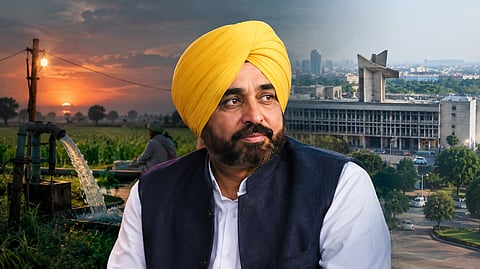

From a farming family in Satauj to the comedy stage, Parliament and finally the Punjab Chief Minister’s Office, Satauj to Sansad compresses Bhagwant Mann’s journey into a 45-minute documentary. But the film is not limited to his political rise; it moves between childhood memories, his entertainment career, family recollections and the issues highlighted during his tenure as Chief Minister.
It Begins in Satauj
The documentary starts with Mann’s roots in Satauj, Sangrur, taking viewers back to his childhood in a farming family.
Among the personal memories he recalls is spending nights in the fields waiting for electricity so irrigation pumps could operate. The moment provides a glimpse into rural life and later connects with the film’s discussion around Punjab’s irrigation system, canal water and groundwater.
His government-school background also finds space in the story, giving context to the emphasis the documentary later places on education.
From the Fields to the Comedy Stage
The story then moves away from agriculture and into entertainment.
Before entering electoral politics, Mann established himself as a comedian and satirist, using humour to comment on everyday life, society and politics.
The documentary brings in people who knew him during that phase, including actor Binnu Dhillon, comedian-actor Karamjit Anmol and singer-politician Mohammad Sadiq. Their recollections help explain the public personality Mann had already built before entering politics.
The Shift to Politics
Mann’s transition from performer to politician forms the next major chapter.
The film traces his early political association with the People’s Party of Punjab before his move to the Aam Aadmi Party.
His election to the Lok Sabha from Sangrur in 2014, followed by his re-election in 2019, marked his transition from a popular performer to an elected representative.
The documentary then moves towards the political breakthrough of 2022, when the AAP formed the government in Punjab and Mann became Chief Minister.
The People Behind the Public Figure
The film also brings in Mann’s family to offer a more personal perspective.
His mother Harpal Kaur and sister Manpreet Kaur speak about his childhood and his journey. His wife, Dr Gurpreet Kaur, also features in the documentary.
These accounts provide a different perspective from the political timeline, focusing on the person they knew before he became one of Punjab’s most recognisable political figures.
Bhagat Singh as an Influence
Another personal thread is Mann’s admiration for Shaheed Bhagat Singh.
The Chief Minister speaks about Bhagat Singh as an inspiration and links that influence to his own understanding of public life and representing ordinary people.
The reference adds a historical and personal dimension to the documentary’s account of Mann’s political identity.
From His Story to His Government
The latter part of the documentary shifts towards Mann’s tenure as Chief Minister and the initiatives his government highlights.
Education, healthcare, women’s welfare, the anti-drug campaign, citizen services and irrigation are among the subjects covered.
The film features initiatives including the Mukh Mantri Sehat Bima Yojana, women-focused welfare measures, the ‘Yudh Nashean Virudh’ anti-drug campaign and ‘Bhagwant Mann Sarkar Tuhade Dwar’
Punjab’s Water Question
The irrigation segment circles back to Mann’s childhood memories.
His recollection of waiting for electricity in the fields is connected with the government’s emphasis on canal irrigation and reducing dependence on groundwater.
It gives the documentary a narrative loop — an experience from his childhood is revisited years later in the context of a major challenge facing Punjab’s agriculture.
From Satauj to Chandigarh
The documentary was shot across locations associated with Mann’s journey, including his home and fields in Satauj, the Punjab Civil Secretariat and the Chief Minister’s residence in Chandigarh.
Visually, the locations underline the distance travelled — from village fields to the centre of state power.
The 45-Minute Picture
Ultimately, Satauj to Sansad is structured around a simple journey: village boy, performer, politician, Parliamentarian and Chief Minister.
What makes the documentary broader than a conventional political timeline is the way it mixes personal memories and family voices with Mann’s career and the issues his government chooses to showcase.
At 45 minutes, it offers a compact look at the many stages of Mann’s public life — while leaving viewers to decide where the personal story ends and the political narrative begins.
