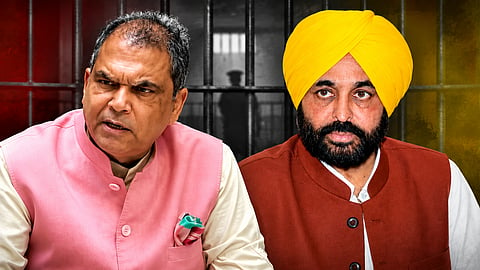

Punjab Chief Minister Bhagwant Mann is set to travel to Gurugram today to meet Punjab Cabinet Minister Sanjeev Arora, who is currently lodged in Bhondsi Jail in connection with an Enforcement Directorate (ED) money-laundering case. The meeting is significant not only because of Arora’s ongoing legal battle but also because of the political message that a Chief Minister meeting a serving Cabinet colleague in jail could send to the AAP organisation, its leaders and workers.
A Chief Minister personally visiting a serving Cabinet Minister in jail is an unusual political development. Arora is currently facing serious allegations in an ED case, but he has not been convicted by any court.
Against this backdrop, Mann’s decision to meet Arora can be viewed as a gesture of political solidarity. It may also reassure AAP leaders and workers that the party leadership is not distancing itself from Arora while the legal proceedings continue.
However, there is no basis at this stage to describe the meeting as an officially announced election strategy. Its political significance is an interpretation of the timing and circumstances surrounding the visit.
One important point needs to be made clear: Sanjeev Arora has not ceased to be a Punjab Cabinet Minister. Following his arrest, his portfolios were redistributed among other ministers, while he was expected to continue as a member of the Cabinet without a portfolio.
Before his arrest, Arora had held several important portfolios, including Industries and Commerce, Investment Promotion, Power and Local Government. In January 2026, the Local Government portfolio was added to his responsibilities.
After his arrest, the Punjab government redistributed these responsibilities. Tarunpreet Singh Sond was given the Power portfolio, Harjot Singh Bains was assigned Local Government, while Aman Arora received Industries and Commerce and Investment Promotion.
Therefore, describing Sanjeev Arora simply as a “former Punjab minister” would be misleading.
The Enforcement Directorate arrested Sanjeev Arora on May 9, 2026, following searches linked to an alleged money-laundering case involving Hampton Sky Realty Limited and related entities. The case concerns alleged financial irregularities and GST-related fraud.
The ED has alleged that the case involves proceeds of crime of around ₹100 crore and alleged irregularities involving transactions, documentation and GST refunds.
These are allegations made in the course of the investigation. They have not been established as guilt by a court, and Arora remains entitled to due process under law.
Following Arora’s arrest, the Punjab government moved quickly to redistribute his major departments to ensure that the administration continued to function.
Tarunpreet Singh Sond was given charge of Power, Harjot Singh Bains received Local Government, and Aman Arora was assigned Industries and Commerce and Investment Promotion.
This redistribution of portfolios did not itself mean that Arora had resigned from the Cabinet or had been removed as a minister.
Mann’s latest visit also comes after an earlier meeting between senior AAP leadership and Arora following his arrest.
The political significance of today’s visit therefore lies partly in its continuity: the Chief Minister is again personally meeting a serving Cabinet colleague while the latter remains in judicial custody.
For AAP leaders and workers, the visit can be interpreted as a message that the party leadership continues to stand by Arora politically while allowing the judicial process to take its course.
The timing of the meeting is likely to attract political attention because Punjab is moving towards another important electoral phase.
For the AAP leadership, maintaining organisational unity will be important as the party prepares for the next electoral contest. Against this backdrop, Mann’s decision to meet Arora may be seen as an attempt to send a broader message of solidarity to the party organisation.
That does not necessarily mean the meeting is directly linked to an election strategy. Rather, its political importance comes from the circumstances: a serving minister facing an ED case, a Chief Minister choosing to meet him personally, and an AAP organisation already entering a politically important period.
Politically, the meeting can be interpreted in three ways.
First, it may signal that AAP does not intend to abandon one of its senior leaders merely because he is facing an investigation.
Second, it may reassure party workers that the leadership remains united during a period of legal and political pressure.
Third, it may communicate to the wider public that the government and the party distinguish between allegations being investigated and guilt being legally established.
These are political interpretations of the visit and should not be presented as an official AAP statement unless the party itself makes such a statement.
Name: Sanjeev Arora
Position: Punjab Cabinet Minister — currently without portfolio
Previous portfolios: Industries & Commerce, Investment Promotion, Power and Local Government
Arrested: May 9, 2026
Agency: Enforcement Directorate
Case: Alleged money-laundering and GST-related financial irregularities
Current status: In judicial custody at Bhondsi Jail, Gurugram
Legal status: Proceedings are ongoing; the allegations have not been established as guilt by a court.
Bhagwant Mann’s decision to meet Sanjeev Arora in jail is therefore more than a routine political visit. It places the Chief Minister directly alongside a serving Cabinet colleague at a time when Arora is facing a major legal challenge.
For AAP, the visit can be viewed as a visible demonstration of political solidarity. For the Opposition, it is likely to invite scrutiny over the government’s handling of the case. For the public, the key distinction remains clear: Arora is facing allegations and legal proceedings, but those allegations cannot be treated as a conviction unless and until a court establishes guilt.
With Punjab heading towards another politically significant phase, Mann’s meeting with Arora is likely to be watched closely for both its political symbolism and its message to the AAP organisation.
