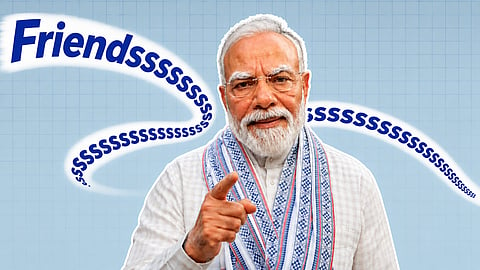

Prime Minister Narendra Modi's way of communicating with the public has changed significantly over the years. from formal speeches beginning with "Mitron" to selfie-style Instagram videos starting with "Hello friends," his messaging has evolved alongside changing technology and audience preferences.
Political observers say this shift reflects how social media, especially Gen Z users, are reshaping political communication in India.
When Narendra Modi first became Prime Minister in 2014, he became widely associated with the word "Mitron" (friends) and the greeting featured in several speeches, including his 2016 address announcing demonetisation. Over time, the word became one of the most recognised parts of his public speaking style and it was also widely shared in memes and jokes on social media, with even an entry appearing on Urban Dictionary.
However, official speech records tell a different story, according to an analysis of Prime Minister's Office transcripts, Modi actually used "Bhaiyo aur Beheno" (brothers and sisters) much more frequently than "Mitron", and the analysis even found that "Bhaiyo-Beheno" appeared more than 750 times, while "Mitron" was used only 61 times across around 40 speeches, along with this the data also showed that by 2016 and 2017, the use of "Mitron" had already started declining, while the more casual term "Doston" (friends) began appearing more often.
Ahead of the 2019 Lok Sabha elections, Modi introduced another major communication strategy through the "Main Bhi Chowkidar" campaign and after political opponents used the term "Chowkidar" (watchman) to criticise him, Modi turned it into a campaign slogan and even changed his Twitter display name to "Chowkidar Narendra Modi," encouraging supporters to adopt the same title and the campaign quickly spread across social media and became one of the BJP's biggest online outreach efforts during the election.
Around the same period, Modi also supported digital campaigns built around social media participation and in 2015, he promoted the #SelfieWithDaughter campaign started by Haryana activist Sunil Jaglan through his Mann Ki Baat programme. Calling it a "silent revolution," Modi encouraged people to share selfies with their daughters to promote the value of the girl child, although it was not a selfie campaign featuring Modi himself, it showed an early effort to use social media trends to spread public messages.
The biggest shift in Modi's communication style came in 2026 during the controversy surrounding the alleged NEET-UG paper leak and the Cockroach Janta Party protests, where instead of relying only on traditional televised speeches or official statements, Modi shared a front-camera, selfie-style Instagram video late at night.
The video reportedly began with the words "Hello friends," marking a noticeable departure from his earlier formal style.
Reports said the video was uploaded around 11:52 pm and crossed 300 million views within 24 hours and it also reportedly helped Modi gain nearly one million new Instagram followers, some reports claimed that the video's engagement even surpassed the FIFA World Cup reel posted by popular YouTuber IShowSpeed, however, these figures have not been independently confirmed by Instagram.
Modi remains the first world leader to cross 100 million followers on Instagram. He also follows no accounts on the platform, making his social media presence unique among global political leaders.
The selfie video was followed by two more similar videos during the peak of the protests, in these clips, Modi addressed concerns related to examination irregularities and spoke about proposed reforms. Compared to traditional speeches, the videos appeared shorter, more direct and designed for social media platforms where younger audiences spend more time and the change was reportedly not limited to Modi alone.
According to reports, Modi advised Union ministers during a Cabinet meeting to become more active on Instagram and use Reels to reach younger citizens, he reportedly told ministers that young people are now primarily on Instagram and that the platform represents an important audience for public communication. Since the remarks were reported second-hand and are not part of an official Cabinet transcript, they remain attributed to those media reports.
Following this reported advice, the BJP's online communication style also appeared to change and political content on party-linked social media accounts increasingly included short Reels, pop-culture references, internet slang and lighter visual formats aimed at younger users, analysts linked this shift to the growing influence of Gen Z voters and the viral success of youth-led online protest movements.
