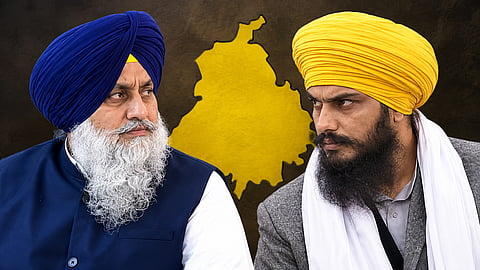

The growing electoral footprint of Akali Dal (Waris Punjab De) is emerging as one of the more significant variables in Punjab's 2027 Assembly election, particularly for the Shiromani Akali Dal (SAD) and the immediate question is not whether Waris Punjab De can win a large number of Assembly seats.
The bigger question is whether it can draw enough votes from the traditional Panthic space to alter the result in closely fought constituencies and that possibility helps explain why SAD president Sukhbir Singh Badal has stepped up his attacks on Waris Punjab De in recent weeks.
The starting point for any assessment of Waris Punjab De's electoral potential is the 2024 Lok Sabha election. Amritpal Singh contested the Khadoor Sahib parliamentary seat as an Independent candidate, not as a Waris Punjab De candidate. He won with 4,04,430 votes — 38.62% of the vote — defeating Congress candidate Kulbir Singh Zira by 1,97,120 votes, while AAP's Laljit Singh Bhullar polled 1,94,836 votes, while SAD candidate Virsa Singh Valtoha received 86,416 votes.
The more significant statistic, however, came at the Assembly-segment level.
The Khadoor Sahib Lok Sabha constituency contains nine Assembly segments. Amritpal led in eight of them. Congress led only in Kapurthala.
Amritpal was an independent candidate in 2024 and that election had its own political circumstances, but the result demonstrated that a Panthic candidate outside the established parties could mobilise a substantial vote across a large geographical area.
The concern becomes clearer when the 2024 result is placed alongaside SAD's own performance.
SAD won only one of Punjab's 13 Lok Sabha seats in 2024, while its statewide vote share fell to roughly 13.4%, while in Khadoor Sahib specifically, SAD was pushed to fourth place with 86,416 votes, behind Amritpal Singh, Congress and AAP.
For a party whose historical strength has depended heavily on the Panthic vote, the emergence of another organisation seeking to occupy that political space represents a strategic challenge and the threat is therefore not necessarily that Waris Punjab De will defeat SAD everywhere and it is that even a relatively modest transfer of Panthic votes could change the winner in a close three- or four-cornered contest.
Sukhbir Badal has made the issue increasingly central to his political messaging, and while addressing a rally in Ghanaur, he described Waris Punjab De as a "virus" and alleged that it had been created to split the Sikh vote and weaken SAD, he urged voters to remain united under the SAD banner.
These are political allegations by Sukhbir Badal and have not been independently established as fact.
His attacks have continued into September.
Sukhbir has accused Waris Punjab De of contributing to unrest and disturbing social harmony and he has also questioned the credentials of people claiming to represent the "heirs of Punjab". The intensity and frequency of these attacks suggest that SAD does not view Waris Punjab De simply as another small electoral outfit.
The biggest development ahead of the 2027 Assembly election is that Waris Punjab De is now moving beyond the Amritpal-centric Khadoor Sahib narrative and the party has announced Satwant Singh from Bassi Pathana. Papalpreet Singh has also been named from Majitha.
The party had earlier indicated that it intended to announce a large number of candidates, with its leadership talking about announcing 50–60 candidates as part of its preparations for the Assembly election and that would represent a very different political proposition from simply contesting a few symbolic seats.
Based on the 2024 data, it would be misleading to say that Waris Punjab De can "lead in eight Assembly seats" in 2027.
What can be said is that Amritpal's 2024 campaign produced leads in eight of the nine Assembly segments of Khadoor Sahib, providing the clearest available electoral evidence of the support that a Panthic candidate outside the traditional parties can potentially mobilise, and the next test is whether that support can be transferred from an individual candidate to an organised political party.
If Waris Punjab De succeeds in doing that, its influence could extend beyond Khadoor Sahib.
For SAD, the calculation is particularly sensitive.
The party is attempting to rebuild after a sharp decline in its electoral performance, while simultaneously defending the political space traditionally associated with the Akali movement. Waris Punjab De does not necessarily have to defeat SAD directly, so if it takes 5–10% of the vote in a closely contested constituency, that alone could potentially determine which of the larger parties wins.
This is why the 2027 contest could become less about the number of seats Waris Punjab De itself wins and more about how many seats it changes the arithmetic in.
Punjab's 2027 election could therefore see a much more fragmented Panthic political landscape.
SAD will attempt to retain its traditional base. Waris Punjab De is trying to build a new organisational structure around Amritpal Singh's political influence and other Akali and Panthic groups will also seek space. The 2024 Khadoor Sahib result has already demonstrated the potential of an alternative Panthic mobilization, so the unanswered question is whether that mobilisation can now be converted into a sustainable party organisation.
