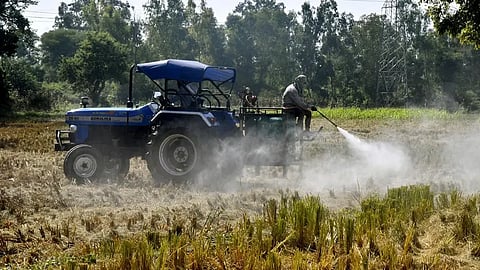

The Delhi government has introduced free bio-decomposer which can spray across 5,000 acres of farmland. This works as an alternative to stubble burning which is one of the reasons of increasing pollution in the national capital.
Delhi Development Minister Gopal Rai said, “In order to solve the problem of pollution occurring in the winter season inside Delhi, the Kejriwal government is constantly moving towards making its Winter Action Plan by meeting with different departments. Stubble burning, included in this year's 21 focus points, also plays an important role in increasing the problem of pollution in the winter season.”
“Paddy is cultivated only in some parts of Delhi. To prevent pollution from stubble in Delhi, the government sprayed bio-decomposer free of cost last year and its results have been very positive. With its spraying, the stubble decomposed in the fields and an increase in the fertility of the fields was also seen. Another problem faced by the farmers is that the time gap between harvesting of paddy crops and sowing of wheat is less. Therefore, the government has started preparations for its spraying in time, so that there is no delay in the whole exercise and the farmers can get better results,” he further added.
Bio-decomposer is a microbial liquid spray which is sprayed into paddy stubble in order to break it down in a way that it can get easily absorbed into the soil so that the farmers do not have to burn the stubble. It is a fungi-based liquid solution which softens the hard stubble to the extent that it gets mixed with the soil in the field and act as compost. This microbial liquid is developed by the Indian Agricultural Research Institute (IARI).
This liquid solution quickly converts the crop residues, animal waste, dung and other waste into organic manure. By converting the subtle into manure and compost for the crops, this liquid eventually helps in improving the fertility and productivity of the soil.
This liquid solution developed by IARI has become an efficient, effective and cheaper technique to prevent stubble burning. This solution should be sprayed after harvest, ploughed into the soil, and lightly irrigated so that the stubble can get decomposed in a period of 20 to 25 days.