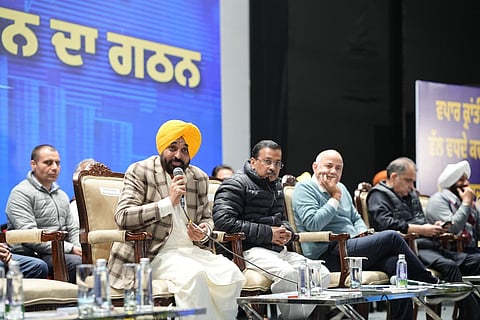

During the maiden meeting of the Punjab State Traders Commission held in SAS Nagar, Aam Aadmi Party (AAP) National Convenor Arvind Kejriwal and Punjab Chief Minister Bhagwant Singh Mann marked the commission as a decisive step to end years of neglect and bureaucratic harassment faced by traders. The AAP Chief said shopkeepers would no longer be forced to run from office to office, as the AAP government has taken governance directly to markets.
Declaring the initiative as the beginning of a new era of business reform in Punjab, Arvind Kejriwal said the commission would simplify the tax system, end an era of tax terrorism, and remove needless procedural hurdles. CM Bhagwant Singh Mann, echoing the sentiment, underlined that shopkeepers were the true patriots who drive the economy and expressed confidence that the commission would decisively safeguard the welfare and dignity of traders across the state.
Addressing the gathering, AAP National Convenor Arvind Kejriwal stated, “Today, a new beginning is taking place for small shopkeepers, traders and markets, towards whom no one ever paid attention until now. All those who have been made members of these commissions at different levels and have been given this responsibility, I congratulate all wholeheartedly. Our government has completed four years, and a very beautiful scene caught my attention just now. All of you sitting in this hall are not our party workers. You are independent people. Some of you are presidents of market associations, some represent sector wise trade associations like textiles and tiles, and you come from different backgrounds. You are all independent individuals.”
Reflecting on public sentiment after four years of governance, he continued, “It is often said that after four years, strong anti incumbency sets in and people become angry for one reason or another. Before us, there was the Congress government, and before that, the Shiromani Akali Dal government. After four years, they would face such abuse that I do not think the Congress government would have had the courage to pass around a microphone in a public gathering and say, speak whatever you want. If the microphone had been passed around during the Congress government, they would have been showered with abuses. If it had happened during the Akali Dal government, the microphone would not have returned, so much abuse would have followed. I listened very carefully just now and heard people praising the work, that it has worked well over four years.”
Speaking about perceptions of traders, Arvind Kejriwal said, “Till now in our country, traders and businessmen have been viewed with a very negative mindset. No matter which governments came or which parties ruled, everyone treated traders as thieves. Every government thinks they are thieves and should be looted. The government extracts money through taxes. The entire Goods and Services Tax (GST) regime exists, and we cannot change it right now. I pray that one day our government is formed at the Centre and we free you from GST. There is a kind of tax terrorism going on. On one side, the government squeezes you through taxes, and on the other side, political parties squeeze you as well. They remember you only during elections, to extract money in the name of donations, and throughout the five years to take bribes. All governments consider traders to be thieves. But, we do not think like that.”
Sharing his personal connection, he added, “I come from a trading family. I understand the pain and suffering of a trader. You may remember how, as children, we used to go to the village during summer holidays. My uncle there, had a grocery shop at the bus stand. During summer vacations, many times I would manage the entire shop alone for days. I understand the pain of a shopkeeper. He works day and night, takes huge risks, earns very little, pays taxes to the government from that income, provides jobs to people, supports his family, and all charitable and social activities in the village or city are funded by his earnings. Despite all this, governments trouble him. I understand your pain.”
Linking trader welfare to national progress, the AAP Chief asserted, “I also understand that no country can progress until it protects even its smallest shopkeeper and provides him facilities. Governments talk about big investments everywhere. In Punjab too, like other states, there are initiatives like Invest Punjab. That is not wrong and should happen. They talk about industries worth ₹3,000 crore, ₹4,000 crore or ₹10,000 crore coming in. That is good and should happen. But no one ever paid attention to the small shopkeeper running a grocery store, a clothing shop, a bread shop, a tile shop, or shops in small markets. For the first time, a government has come where the small shopkeeper does not need to wonder whether to approach someone through recommendation or pay a bribe to get his work done. This has to stop.”
Explaining the new commission structure, he elaborated, “We are creating a system through which you will become part of the government. There will be a commission at the state level, then at the district level, and most importantly, at the constituency level. At the constituency level commission, there will be traders along with local police and administration. They're responsible to approach every shopkeeper in markets and hold a meeting. The problems faced by shopkeepers will be discussed in these meetings. Individual shopkeepers may have personal problems, where someone says they have been running around for months and their work is not getting done. There may be market level problems such as broken roads, lack of toilets, drinking water issues, difficulties for traders and customers, and even law and order problems. Ninety percent of these problems will be solved at that level itself.”
Addressing policy level concerns, Arvind Kejriwal said, “Some issues will be at the policy level, which these committees will recommend to the state government and get fixed, including new policy suggestions. The OTS policy, for example, was made by previous governments, but they never intended to implement it. It was designed in such a way that it could never be implemented. If we make policies after talking to people, those policies will be implemented, and through these commissions, those policies will also reach you.”
Concluding, the AAP Supremo stated, “I am very happy that all these commissions are being launched by theAAP government. We hope that within the first three months, one round of meetings across all small and big markets in Punjab will be completed. Problems that can be solved on the spot will be resolved there, and those that need to go to the state level will be addressed at that level. After three months, the next round of meetings will be held.”
Addressing the gathering, Punjab CM Bhagwant Singh Mann said, “This is a unique programme taking place in Punjab, something that never happened under previous governments. The sky is the limit for the progress and prosperity of every individual, and this path-breaking initiative has been launched especially for the welfare of small shopkeepers. The AAP was constituted by Arvind Kejriwal not to indulge in politics, but to change politics itself and to teach the country the meaning of value-based politics.”
Highlighting the people-first approach of his government, the Chief Minister said that the sole objective behind assuming charge was to serve the people, a commitment clearly reflected on the ground. “More than 61,000 youth of Punjab have been given jobs purely on merit. We have closed over 17 toll plazas, saving nearly ₹64 lakh every day from the pockets of common people. To further facilitate citizens, the vacant offices at these toll plazas will now be converted into Aam Aadmi Clinics,” he said.
Drawing a contrast with previous governments, the Chief Minister said that while politicians of traditional parties amassed massive personal wealth, traders and shopkeepers were left struggling with meagre earnings. “I urge shopkeepers to prepare a detailed roadmap to boost the state’s development and strengthen the economy. Government revenue has already increased manifold, and every rupee will be spent judiciously for the development of Punjab and the prosperity of its people,” he stated.
Speaking on Punjab’s social ethos, CM Bhagwant Singh Mann said that the sacred land of Punjab has always stood at the forefront of helping people in distress. “Punjabis never step back when it comes to serving the needy. Those who have usurped money meant for religious purposes or offerings made before the Almighty will not be spared. Exemplary action will be taken against such sinners,” he said, adding that the state government is making continuous and strenuous efforts for the welfare of every section of society.
Terming shopkeepers as the true patriots of the nation, the Chief Minister said, “Traders serve the country in the real sense by driving the economy. Those who sold the country and are holidaying in obscure foreign destinations have put Arvind Kejriwal behind bars because he worked honestly for the welfare of the common man.” He further said, “The Union government is working day and night for its industrialist friends, while depriving the poor of food by discontinuing schemes like MGNREGA.”
The Chief Minister said that while the Punjab Government is committed to paying salaries to poor workers, the Union government must release the legitimate share of funds pending with the Centre. “I had promised that governance would be run from villages and towns, not confined to offices. That promise has been fulfilled,” Bhagwant Singh Mann said, congratulating all commission members on their new responsibilities and expressing confidence that they would act as catalysts in Punjab’s development.
Addressing the gathering, senior AAP leader and Punjab Prabhari Manish Sisodia said that the prosperity of traders depends directly on the intent of the government. “Traders are the backbone of Punjab’s economy, yet for years they were forced to run from pillar to post to get their work done. To address this, the state government has constituted this commission. For the first time in the country, traders are truly being empowered,” he said.
Manish Sisodia said that traders have now been given the authority to help set the system right. “The members of this commission understand the problems of traders because they come from the same background. This initiative will give a major boost to trade and commerce in every nook and corner of Punjab, with traders’ issues being resolved at their doorsteps,” he said, adding that this model would pave the way for trader welfare policies to be implemented across the country.
Manish Sisodia said, “The Punjab State Traders Commission has been constituted, and this commission will get work done for the people directly from within the markets and for the traders. It will improve the condition of the markets and ensure that even the small, day-to-day issues of local markets are addressed. There are many routine works related to local markets that need attention, and shopkeepers often face problems for which they earlier had to run around. Now, they will not have to go anywhere, because the government itself will reach them. The condition of local markets will improve, and their overall picture will change.”
