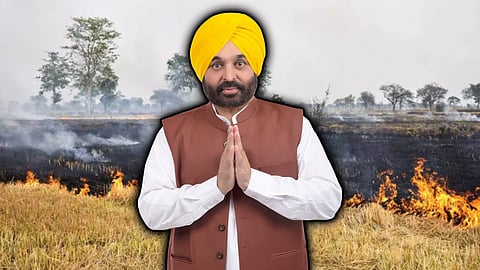

Rajesh Verma, Chairman of the Commission for Air Quality Management (CAQM), recently visited the Rajpura Thermal Plant, not to issue warnings or fines, but to recognize an extraordinary achievement—Punjab’s farmers leading what he calls the “stubble revolution.”
Under the guidance of Chief Minister Bhagwant Singh Mann, Punjab’s farmers are not only producing food but also protecting the environment by adopting alternatives to stubble burning.
The impact is striking. In 2021, Punjab recorded 71,300 incidents of stubble burning. By 2024, that number fell to 10,900, marking an 85% reduction. So far this year, only 3,284 incidents have been reported, signaling a transformative change in agricultural sustainability.
But the numbers tell only part of the story. The shift reflects a fundamental change in how Punjab’s farming community views its environmental responsibility.
“Rice straw has now become a source of income for farmers,” Verma noted during his visit. What was once discarded and burned is now converted into biomass fuel for thermal plants, contributing to a sustainable green revolution.
The Commission chief’s review of biomass-coal mixing at the Rajpura Plant highlights a broader truth: Punjab’s farmers are no longer just cultivating crops—they are creating solutions. This initiative has opened new income streams for farming families while tackling one of North India’s most pressing environmental issues.
This transformation required strategic investment, including infrastructure for biomass collection, educational programs for farmers on alternative uses for crop residue, and government support to make these options economically viable. The Aam Aadmi Party government’s focused approach has created a model now being studied by other states.
The contrast with neighboring regions is evident. While Punjab’s air quality has improved significantly, Delhi continues to struggle despite administrative measures. The difference lies in Punjab addressing the problem at its source, working collaboratively with farmers rather than imposing top-down directives.
“This year’s sharp decline in stubble burning incidents compared to last season shows how farmers are leading the ‘stubble revolution,’” Verma emphasized, acknowledging that real change is rooted in ground-level action and community participation.
For Punjab’s farmers, this revolution represents more than environmental compliance—it is a reclaiming of their role as protectors of the land and innovators adapting to modern challenges while preserving their agricultural heritage. The “stubble revolution” demonstrates that environmental responsibility and agricultural prosperity are complementary goals.
As Diwali approached, Punjab’s skies remained clearer than in previous years, offering North India an early gift: proof that community empowerment, alternative solutions, and government support lead to benefits for all.
This is Punjab’s story—a story of transformation, responsibility, and leadership, written by the people who feed the nation under the guidance of Chief Minister Bhagwant Singh Mann.
