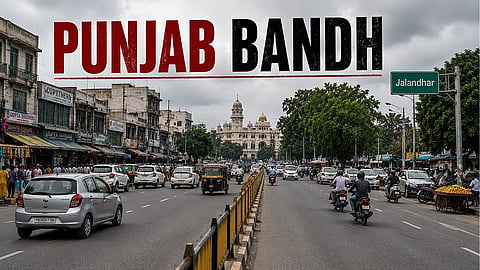

The Punjab bandh observed on Thursday was not just about closed markets or disrupted traffic. It reflected the growing anger among sanitation workers and the Valmiki community following the police lathi-charge on protesters in Barnala on July 22. What began as a protest over workers' demands has now evolved into a larger debate on police action, workers' rights, and the government's response.
Districts with shutdown
The bandh call, given by the Valmiki community, received support from several districts, including Amritsar, Gurdaspur, Pathankot, Ludhiana, Bathinda, Hoshiarpur, Fazilka, Kapurthala and Patiala. In many of these cities, markets remained shut and sanitation workers held demonstrations. In Amritsar, protesters blocked Bhandari Bridge, while in Pathankot, sanitation workers locked the Municipal Corporation office and staged a protest.
Jalandhar remains open
However, the response was not uniform across Punjab. In Jalandhar, shops and commercial establishments remained open, although sanitation workers continued their sit-in protest inside the Municipal Corporation premises.
Reason of the protest
The bandh was called in response to the police action in Barnala, where sanitation workers protesting over their demands were allegedly lathi-charged. Protesters have claimed that several workers were injured, including women, and have demanded strict action against the officials responsible. The incident quickly drew attention across the state, prompting criticism from various social organisations and workers' unions.
Escalation of the matter
The matter has also reached national-level authorities. The National Commission for Safai Karamcharis visited Barnala, met the injured workers, and held discussions with district officials and police. The Commission has stated that no official found responsible will be spared and has indicated that the matter could be taken to the Supreme Court if necessary. Separately, other statutory bodies have also sought reports on the incident, while the Punjab government has initiated departmental action against some police officials and ordered an investigation.
For many sanitation workers, the issue goes beyond a single day of violence. They argue that their long-pending demands regarding working conditions, job security and dignity have remained unresolved for years. The Barnala incident has only strengthened their resolve to seek accountability and better treatment.
Investigation on the matter
As investigations continue, the focus will remain on whether the inquiry is conducted fairly and whether those found responsible are held accountable. At the same time, the government faces the challenge of rebuilding trust with sanitation workers while ensuring that future protests are handled through dialogue rather than confrontation.
The Punjab bandh has highlighted one clear message: when a section of essential workers feels unheard, the impact extends far beyond a single protest. The coming days will determine whether this episode leads to meaningful reforms or becomes another unresolved chapter in the state's labour and law-and-order history.
