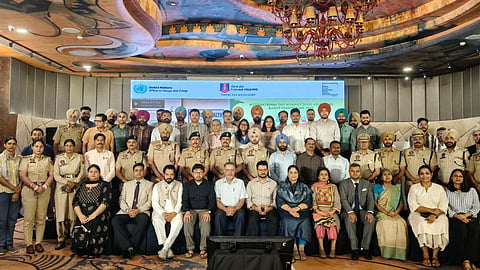

A high-level stakeholder consultation on Drugs, HIV and Prison Health was held in Ludhiana on Friday to reaffirm Punjab’s commitment to ensuring comprehensive healthcare and rehabilitation for jail inmates. The event was organised by the United Nations Office on Drugs and Crime (UNODC) in collaboration with the Punjab Prisons Department and the NGO TYCIA to mark the International Day Against Drug Abuse and Illicit Trafficking.
The day-long consultation brought together state officials, prison officials and healthcare experts from across Punjab and the country to focus on strengthening prison healthcare systems and rehabilitation services for inmates.
Addressing the inaugural session, Health and Family Welfare Minister Dr. Balbir Singh highlighted the state’s ongoing efforts to strengthen de-addiction and mental health services as part of the Bhagwant Mann Government’s Yudh Nashean Virudh campaign and stressed the importance of coordination among different stakeholders in addressing the challenges associated with substance use.
He added, “One of the key steps we have taken is to decriminalise drug addiction. There is a clear distinction between patients and peddlers. In the last one year and three months, over 10,000 addicts who would otherwise have been in jail have instead been admitted to de-addiction centres. We have also screened 25,000 inmates for Hepatitis, HIV and drug addiction. We believe that jails should function not merely as correctional institutions but also as places of treatment, rehabilitation and recovery. Punjab already has a network of OOAT clinics across prisons, helping inmates manage and recover from addiction. Apart from that, ITI courses for skill development, along with psychiatrists and counsellors, are available for inmates.”
Addressing prison officials from across the state, Punjab Jail Minister Dr. Ravjot Singh said, “Punjab stands first when it comes to convictions under the Narcotic Drugs and Psychotropic Substances (NDPS) Act. Similarly, we must set an example for reformative justice as well. For the Mann Government, eradicating drugs from society and supporting every addict through adequate healthcare go hand in hand.”
The day-long event began with a discussion on emerging health challenges in prisons, followed by a special presentation by IG Prisons IAS Mohammad Tayyab. The event featured a series of thematic sessions focusing on challenges and possible solutions in prison settings, including prevention of drug use and communicable diseases, gender-responsive health services, and exploring the intersection between disability, substance use disorders and incarceration.
Experts from UNODC shared international protocols and global best practices relating to prison health and rehabilitation. The deliberations underlined that access to healthcare is a fundamental human right and that continuity of treatment and psychosocial support must be made available to inmates both during incarceration and after their release.
Speaking at the event, Ms. Seema Joshi, Criminal Justice Expert with the UNODC Regional Office for South Asia, said, “This year’s theme, ‘World Drug Problem: Persisting Issues, New Challenges, Innovative Responses,’ reminds us that while challenges continue to evolve, so too must our responses. Today is not only about acknowledging the impact of drugs on individuals, families and communities, but also about promoting solutions, partnerships and hope. Strengthening prison health, drug treatment and HIV services is a critical part of that response, helping individuals recover and reintegrate while building safer and healthier communities.”
Experts brainstormed on screening mechanisms, withdrawal management, opioid dependence treatment, psychosocial interventions and continuity of care. Educational tools, including specially designed games on drugs and HIV, were also introduced to facilitate engagement and awareness among stakeholders.
The discussions also centred on reproductive health, mental health support and continuity of care for women affected by substance use disorders during and after incarceration.
The consultation concluded with a resolution among all stakeholders to strengthen collaboration and adopt a comprehensive, rights-based approach to addressing substance abuse in custodial settings across the state.
