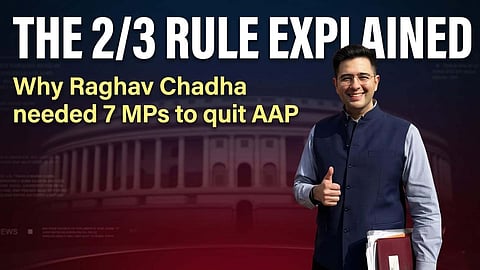

In a major political development Raghav Chadha on Friday resigned from the Aam Aadmi Party (AAP) and joined the Bharatiya Janata Party (BJP) along with six other Rajya Sabha Members of Parliament and the move has triggered intense debate across political circles especially because of how it interacts with India’s anti-defection law.
Raghav Chadha was joined by six other AAP Rajya Sabha MPs that are Ashok Mittal, Sandeep Pathak, Harbhajan Singh, Swati Maliwal, Rajinder Gupta and Vikram Sahney in switching sides to the BJP.
While Chadha’s exit was somewhat expected after he was removed as AAP’s deputy leader in the Rajya Sabha earlier this month what truly shocked observers was his claim that two-thirds of AAP’s Rajya Sabha MPs would merge with the BJP and out of 10 AAP MPs in the Rajya Sabha 7 have now moved together and this has reduced AAP’s strength in the Upper House to just three members.
Under normal circumstances if an MP leaves their party they can lose their seat under the anti-defection law but this case is different as the law which is part of the Tenth Schedule of the Constitution clearly states that if at least two-thirds of members of a party join another party together it is treated as a “merger” not defection and since 7 out of 10 MPs shifted together they cross the two-thirds mark which means:
They are unlikely to be disqualified
Their Rajya Sabha membership remains safe
The move is considered legally valid under the Constitution
This is why the number “two-thirds” has become so important in this case.
The anti-defection law is part of the Indian Constitution under the Tenth Schedule which works along with Article 102 of the Constitution of India and it allows disqualification of MPs or MLAs if they:
Voluntarily leave their party
Vote against party instructions (whip)
The aim is simple: to stop political leaders from frequently switching parties for personal gain.
The need for this law came after the 1967 elections when Indian politics saw massive instability when many MLAs were switching parties repeatedly causing governments to collapse and one famous example was from Haryana where an MLA named Gaya Ram changed parties three times in just two weeks which led to the popular phrase “Aaya Ram, Gaya Ram.”
To address this issue a committee was formed under then Home Minister Yashwantrao Chavan which studied defections and suggested reforms and finally the anti-defection law was introduced in 1985 through the 52nd Constitutional Amendment.
Later in 2003 the law was made stricter through the 91st Constitutional Amendment and the key changes included:
Protection given to small group splits within parties was removed
Only large mergers (two-thirds members) were allowed protection
Disqualified members were also barred from becoming ministers
This reform was based on recommendations from a committee led by Pranab Mukherjee which found that desire for power and positions was driving defections.
Even today the anti-defection law has some major loopholes:
No fixed time limit for deciding disqualification cases
Decisions are taken by the Speaker, who may act politically
Cases are sometimes delayed or rushed depending on the ruling party
Because of this many experts call it a “toothless tiger” a law that exists but is not always effective.
Raghav Chadha’s move is not just a political shift but also a textbook example of how the anti-defection law works in real life and by ensuring that two-thirds of MPs moved together the group has legally protected itself while delivering a major political blow to AAP.
