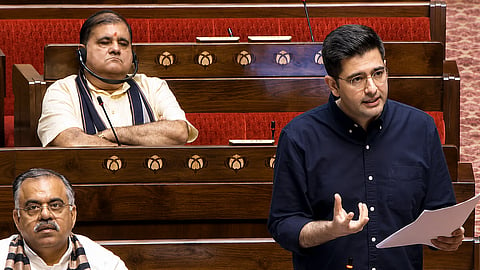

BJP Rajya Sabha MP Raghav Chadha on Thursday explained why he had not spoken publicly on the NEET paper leak issue until now.
Speaking in the Rajya Sabha during the discussion on the Public Examinations (Amendment) Bill, 2026, Chadha said his role had changed after moving from the Opposition to the treasury benches and added that while his earlier responsibility was to raise questions, his responsibility now is to help solve problems.
Addressing the House, Chadha also responded to people who had been asking why he had remained silent on the NEET issue and said many of his well-wishers had asked him when he would speak on the matter, replying to them, Chadha said that when he was in the Opposition, asking questions was his responsibility. Now that he is part of the treasury benches, he believes it is his duty to work towards finding solutions.
Chadha said he could have appeared before television cameras every day and made statements on the issue, however, he said he did not want to speak only to make headlines. Instead, he wanted to wait until a solution was being brought before Parliament.
According to Chadha, his role in the Opposition was to raise issues and question the government. He said he carried out that responsibility honestly, however, he said that after joining the treasury benches, his role is no longer to simply make public statements or "mark attendance" in front of cameras. He said his focus is now on fixing the system.
Chadha told the House that he had made a personal decision to speak on the NEET issue only when Parliament was discussing a solution that could strengthen the examination system. He described the discussion on the Public Examinations (Amendment) Bill, 2026 as the right time to do so because, according to him, the system was now being improved.
During his speech, Chadha expressed support for the proposed legislation and said the bill would help make the examination system stronger and improve the security of public examinations, added that the law aims to ensure that examinations are conducted fairly and that merit is protected.
Speaking about the expected impact of the proposed law, Chadha said fair examinations would help deserving students. He also said that those involved in paper leak cases should face strict action, according to him, the government should act as a watchdog to protect the examination system, while the paper leak mafia should be brought to justice.
In his speech, Chadha said, "The exam will be fair. Merit will be respected. The mafia will be in jail. The government will be the watchman. The action will be powerful. Students will win. Mafia will lose."
He also said that the government had listened to the concerns raised by students across the country. Chadha stated that when it came to students and the youth of India, the government had heard their concerns, taken action and delivered on their key demands.
The Rajya Sabha MP made these remarks during the discussion on the Public Examinations (Amendment) Bill, 2026, which was taken up in the Upper House a day after it was passed by the Lok Sabha.
The proposed bill has been introduced with the aim of preventing paper leaks and strengthening the security of public examinations and according to Chadha, the legislation is intended to improve the examination process, make exams more secure and protect the interests of honest students.
Chadha's remarks came after nationwide protests by students over the NEET paper leak issue and the protests had raised concerns about the fairness and credibility of public examinations. The developments also led to the resignation of Union Education Minister Dharmendra Pradhan, while explaining his stand, Chadha repeated that his approach had changed because of his new role in government and said that raising questions was appropriate when he was in the Opposition, but now his responsibility is to work on solutions that improve the system.
He maintained that meaningful reforms are more important than frequent public statements and according to Chadha, his decision to speak only when Parliament was discussing a legislative solution reflected his focus on achieving results rather than attracting attention.
