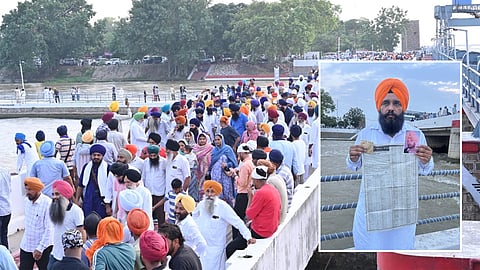

Thousands of people gathered at Harike Pattan on Tuesday for a religious prayer (Ardas) led by Akal Takht Jathedar Giani Kuldeep Singh Gargaj and during the gathering, he announced that a permanent "Shaheedi Pattan Memorial" will be established at the site to remember people who lost their lives or disappeared during Punjab's militancy period.
The Jathedar directed the Shiromani Gurdwara Parbandhak Committee (SGPC) to build the memorial with the support of the Khalsa Panth, he also announced that the Akal Takht, through the SGPC, will prepare and preserve official records of people who were killed between 1982 and 1995.
According to him, these records will include details of those who were allegedly declared "unclaimed" after their deaths and cremated without their bodies being handed over to their families. These records will become part of the official archives of the Akal Takht.
Harike Pattan is located near the confluence of the Sutlej and Beas rivers, however, for many Sikh families and human rights groups, the place carries painful memories linked to Punjab's militancy period. During the years between the early 1980s and mid-1990s, Punjab witnessed a long period of violence involving militants and security forces and thousands of people lost their lives during this period. Human rights groups have for years alleged that many people disappeared after being taken into custody, while others were killed in encounters, it has also been alleged that many bodies were declared "unclaimed," cremated without informing their families, or disposed of in rivers.
Harike Pattan has been mentioned by activists and victims' families as one of the places where bodies were allegedly disposed of during those years. Because of these allegations, the site has become an important place for remembrance and demands for justice.
Addressing the gathering after the collective Ardas, Giani Kuldeep Singh Gargaj remembered those who disappeared during the militancy years and whose bodies were allegedly cremated as unclaimed or disposed of in rivers and said thousands of men, women, children and elderly people lost their lives during that period. He also referred to human rights activist Jaswant Singh Khalra, whose work brought international attention to the issue of alleged illegal cremations in Punjab.
The Jathedar said that governments of that time violated basic human rights by allegedly declaring the bodies of both Sikhs and Hindus as unclaimed and denying them to their families.
He said that while hostility should end after a person's death, those responsible continued their actions even after people had died, during the prayer, he prayed that those responsible are held accountable by the Almighty.
One of the major announcements made during the gathering was the preparation of an official record of victims from the years 1982 to 1995, according to the Jathedar, the Akal Takht will work through the SGPC to collect available details of those who were killed, disappeared, declared unclaimed or cremated without being returned to their families.
These records will be preserved in the Akal Takht's official archives so that future generations have a documented record of the events.
The gathering at Harike Pattan comes at a time when Punjab has witnessed fresh public discussion about the militancy period because of the film "Satluj." The film is based on the life and work of human rights activist Jaswant Singh Khalra, who investigated thousands of alleged illegal cremations in Punjab during the militancy years, recently, the film became the centre of controversy after it was released and later removed, leading to protests by several religious, social and rights groups.
Many organisations claimed that the removal of the film had once again brought attention to unresolved questions related to the disappearances and deaths that occurred during the militancy period. In the days before Tuesday's gathering, several organisations also held torch marches and demonstrations demanding justice for the victims and raising objections over the film controversy.
Tuesday's event witnessed the participation of a large number of youth, religious organisations and political activists and people gathered for the Ardas to remember those who lost their lives during the militancy years. The programme focused on paying tribute to victims and renewing demands for preserving their history, the Jathedar also remembered both Sikh and Hindu victims who disappeared or were killed during that period, saying that all innocent victims deserve to be remembered.
Punjab experienced a violent period from the early 1980s until the mid-1990s, during these years, the state saw armed militancy, counter-insurgency operations and widespread violence.
Thousands of civilians, security personnel and militants lost their lives. Human rights organisations have, for many years, raised concerns over alleged enforced disappearances, illegal cremations and unidentified bodies. One of the most well-known figures associated with these allegations was Jaswant Singh Khalra, who documented cases of unidentified cremations and campaigned for accountability and although several investigations and legal proceedings have taken place over the years, the issue continues to remain emotionally and politically sensitive in Punjab.
The announcement of the Shaheedi Pattan Memorial marks a significant development in efforts by the Akal Takht to preserve the memory of those who died or disappeared during Punjab's militancy years and the proposed memorial aims to serve as a place of remembrance for victims, while the planned documentation project seeks to create an official historical record of people whose deaths or disappearances remain part of one of Punjab's most debated chapters.
The development has once again brought national attention to Harike Pattan, a place that has become closely linked with discussions on Punjab's militancy history, human rights concerns and the demand to remember those who never returned to their families.
