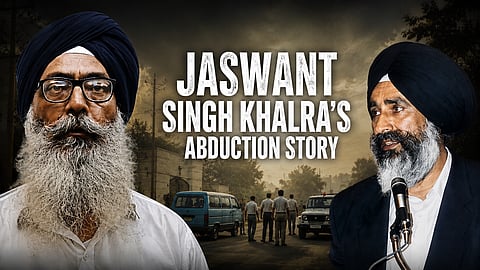

Amid the ongoing controversy over the film Satluj, Rajiv Singh Randhawa, a close associate of Bhai Jaswant Singh Khalra who says he witnessed his abduction, has shared his account of the events of September 6, 1995 and speaking to the media about the same, Randhawa also expressed his views on the film, saying that history should be discussed instead of being suppressed.
According to Randhawa, the period during which Bhai Jaswant Singh Khalra worked was one of the most sensitive chapters in Punjab's history and said the events of that time cannot be erased and that films based on historical events should be allowed to present different perspectives, referring to Sutlej, Randhawa said he believes it attempts to show the events of that period and called the decision to stop its release in India unfortunate.
Recalling the day of Bhai Khalra's alleged abduction, Randhawa said the incident took place on September 6, 1995, at around 9 am at Bhai Khalra's house in Kabir Park, Amritsar and said he was sitting in the drawing room reading a newspaper while Bhai Khalra was outside washing his Tata Mobile vehicle.
Randhawa claimed that a sky blue van arrived at the house, followed by a police gypsy and according to him, several people in plain clothes got out of the vehicles and tried to forcibly take Bhai Khalra with them.
He said he immediately rushed outside and tried to stop them, Randhawa claimed that he told the officials that if Bhai Khalra was required for questioning, he would present himself before the Senior Superintendent of Police (SSP) however, according to Randhawa, his request was ignored and he further alleged that he was pushed aside and Bhai Jaswant Singh Khalra was taken away in a vehicle in front of him.
Randhawa said that soon after the incident, he and Bibi Paramjit Kaur Khalra went to Islamabad Police Station in Amritsar to report the matter and according to him, an FIR was not registered immediately, he further claimed that when the FIR was later registered, it mentioned the kidnapping of Bhai Khalra by unknown persons wearing police uniforms and he said the matter later reached the Supreme Court, after which the Central Bureau of Investigation (CBI) began investigating the case.
Speaking about the controversy surrounding the film Satluj, Randhawa said the movie had earlier been made under a different title and remained in the censor process for a long time and he claimed that after it was cleared for release for some time, it was again banned in India, while audiences outside the country have been able to watch it on different platforms.
Calling the ban unfortunate, Randhawa said that if India is the world's largest democracy, there should be open discussion on historical events instead of stopping films based on them and said many democratic countries allow books, films and documentaries on historical events, wars and government policies to be released so that people can understand different viewpoints and according to Randhawa, India should also encourage discussions on history rather than suppressing them. He said understanding the past is important for society.
Randhawa also spoke about Bhai Jaswant Singh Khalra's work and approach and said Bhai Khalra never supported violence and instead chose to fight through legal and constitutional means, said Bhai Khalra highlighted human rights issues by using lawful methods and believed in seeking justice through the legal system.
He further said that Bhai Khalra's sacrifice should be remembered and honoured because of his efforts to bring important issues before the public through peaceful and legal means and during the interaction with the media, Randhawa also repeated the demand for the formation of a Truth and Reconciliation Commission to examine the events that took place in Punjab between 1984 and 1994.
According to him, such a commission should conduct an impartial investigation into the period and ensure that every innocent person who lost their life, regardless of religion, community or political affiliation, receives justice and said the purpose of such a commission would be to establish the truth and help people better understand what happened during those years.
Randhawa said lasting peace and trust in Punjab can only be achieved by accepting the truth and learning from history. He added that bringing historical facts before the public is important for future generations and that open discussion is necessary in a democratic society.
