
Punjab’s recent rise in the NITI Aayog Education Quality Report 2026 is being seen as a major moment for the state’s education system but the bigger story is not just that Punjab performed better than Kerala on some key learning indicators the real question is: how did this happen?
For years Kerala was considered one of the strongest states in school education and Punjab rarely entered that conversation however according to latest report Punjab scored 82% proficiency in language and 78% in mathematics among Class 3 students while Kerala scored 75% and 70% respectively. In Class 9 mathematics too Punjab performed better with 52% compared to Kerala’s 45%.
Education experts and state officials say this did not happen suddenly and the improvement is being linked to years of changes inside government schools after COVID-19 pandemic and one of the biggest reasons behind this shift is Punjab’s focus on foundational learning and instead of only pushing board exam results government started working on basic reading, writing and maths skills from early classes. Through programmes like ‘Mission Samarth’ schools began focusing more on whether children were actually understanding concepts rather than simply memorising answers.
Infrastructure also played a major role and according to state government nearly all government schools in Punjab now have electricity while 99% have functional computers and more than 80% schools have smart classrooms whereas earlier lack of proper facilities was one of the biggest complaints in many rural schools and officials believe that improving learning environment helped students become more engaged in studies.
Another major factor was teacher training as Punjab sent teachers for training programmes in countries like Finland and Singapore both known globally for strong education systems and the idea was to bring modern teaching methods into classrooms where teachers were trained to make classes more interactive and student friendly instead of depending only on old style lecture methods.
The state also recruited around 13,000 teachers and staff members which improved the student teacher ratio to around 22:1 meaning teachers could pay better attention to students individually and education experts often say overcrowded classrooms reduce learning quality especially for younger children.
Punjab also tried to reduce gap between urban and rural education as earlier students in villages often lacked same opportunities available in cities and the report highlighted that Punjab worked on giving equal access to facilities and quality teaching in rural areas as well which reportedly helped girls and village students perform better.
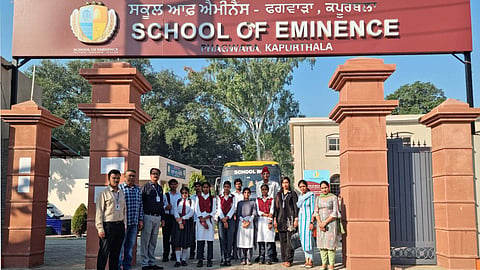
The Schools of Eminence programme is another important part of the story and Punjab established 118 such schools with upgraded facilities and advanced learning support and along with this the ‘English Edge Programme’ was launched for nearly three lakh students to improve spoken and written English skills which many students from government schools struggle with during higher education and competitive exams.
The impact is now becoming visible in competitive exams too and according to government 786 students from government schools cleared JEE Main while 1,284 qualified for NEET and these numbers are being presented as proof that government school students are now competing more confidently at the national level.
Dropout rates have also reportedly reduced and more than 90% of Class 10 students are now moving to Class 11 smoothly and experts say this is important because many students earlier left studies after secondary school due to financial pressure lack of motivation or weak academic support.
Punjab Education Minister Harjot Singh Bains described the achievement as result of “policy, intent and execution” working together and many teachers and parents believe the changes became visible over last few years because schools finally started getting consistent investment and attention.
