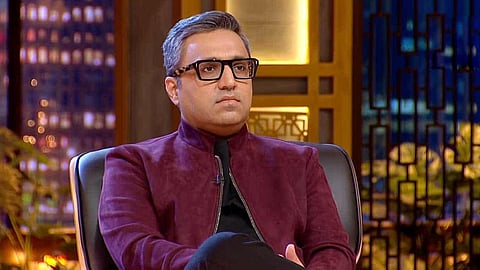

Entrepreneur and former BharatPe co-founder Ashneer Grover has reacted to the recently announced merchant charge on certain UPI transactions above ₹2,000, arguing that the cost could ultimately be passed on to consumers.
The government has clarified that the charge will apply to certain merchant transactions above ₹2,000, while person-to-person UPI payments will continue to remain free irrespective of the amount.
Grover questions the logic behind the charge
Speaking in an interview with Times Now, Grover questioned the decision to impose a fee on merchants accepting eligible UPI payments above ₹2,000.
Responding to the argument that the charge would only affect those who can afford it, Grover said that such a levy should simply be called a tax if the consumer is ultimately expected to bear its cost.
“Then call it tax. Why are you calling it a ‘charge’, ‘MDR’, or claiming that it won't affect the customer?” he said.
Grover also used an example of paying ₹500 every month for breathing to question the logic of arguing that a charge is acceptable simply because people can afford it. A video of his interaction has since circulated widely online.
What is the UPI merchant charge?
MDR, or Merchant Discount Rate, is a charge within the digital payment ecosystem. According to the government, it is not a tax and is not money collected by either the government or the National Payments Corporation of India (NPCI).
The latest clarification also states that person-to-person UPI transactions will not attract the merchant charge, regardless of the transaction amount.
Grover cites RBI, bank and NPCI figures
In a subsequent post on X, Grover cited several figures while questioning the rationale behind the merchant charge.
He claimed that the RBI's surplus transferred to the government stood at ₹2.87 lakh crore, while total listed bank profits stood at ₹4.11 lakh crore. He also cited an NPCI pre-tax surplus of ₹1,888 crore.
Based on these figures, Grover questioned who was actually facing losses from UPI and what subsidy the government was allegedly paying for the payment system.
He further referred to the costs associated with ATMs and cash logistics, suggesting that UPI should instead be promoted as a way to reduce dependence on cash infrastructure.
Will consumers ultimately pay?
While the government has maintained that the merchant charge is part of the payment ecosystem and is not a tax collected by the government or NPCI, Grover argued that consumers could still be affected indirectly.
In the interview, he compared the situation with fuel pricing, arguing that even when a charge is imposed on companies rather than directly on consumers, businesses can factor such costs into the prices paid by customers.
“End of the day who pays? Whether it is tax or any other charge, the consumer pays,” Grover said.
The debate therefore centres on whether merchants will absorb the additional payment-processing cost or pass some or all of it on to customers through pricing or other means.
